
Our goal for young writers is to help them become confident writers who can easily express their ideas in writing. But before they can do that, students need to understand sentences. In this series, we’ll look at six sentence-level skills that help students become more effective writers, beginning with the first skill: identifying sentences and fragments.
Teaching Writing One Step at a Time
I love teaching kids to write. It might just be my favorite subject of all. Well, I love teaching math too, but there is something pretty amazing about watching six-year-olds come into the classroom in the fall, hardly writing much more than their names, and leave in the spring writing sentences—and even paragraphs in some cases.
But teaching children to write isn’t a willy-nilly process, although sometimes I think we treat it that way. There is a logical progression to teaching writing. I think of it a little like following a recipe. You need the right ingredients, and the order matters.
Each writing skill builds on what came before it. When children have the time and practice they need to develop each skill in a developmentally appropriate way, they begin to put all those pieces together. And eventually, our goal is to help them become skilled writers who can—and want to—write for many different purposes.
And for me, it all starts with one very important question:
What Makes a Sentence a Sentence?
A sentence is a group of words put together to share a complete thought. It sounds simple enough, but when you are six, those words can be pretty meaningless. What exactly is a complete thought? So, we have to start at the beginning.
I begin by simply asking students, “What is a sentence?” We record their ideas and tuck them away to revisit later. I don’t spend much time correcting or explaining at this point. I just want to know what they already think they know.
Then I tell them we’re going to figure out what makes a sentence a sentence—and we’re going to begin with two words:
sentence and fragment.
What Is a Fragment?
Well, first I have to find out if they know what a fragment is!
Kids come up with all sorts of examples—fragments of light, fragments of fabric, and sometimes some pretty unexpected answers. My go-to example is a plate. Well, a broken plate.
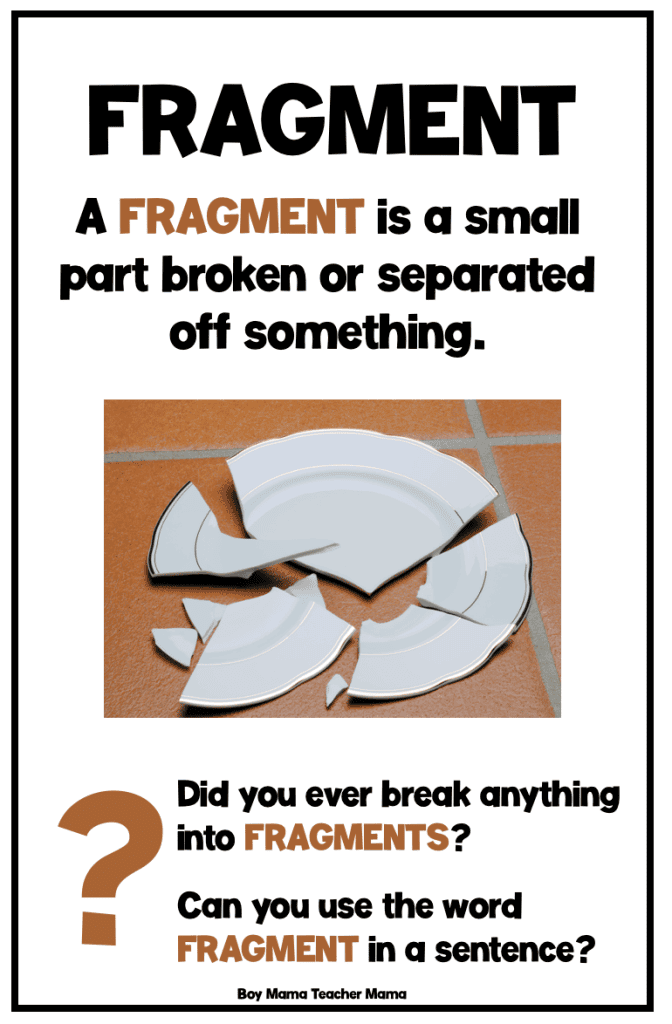
A fragment is a small part that has been broken or separated from something larger. We look at the broken plate and talk about how each piece is only part of the whole. I ask students to think about things they’ve seen broken into fragments and whether they can use the word fragment in a sentence.
Once they understand what a fragment is in the real world, we’re ready to connect that idea to writing.
A sentence fragment is also only part of the whole. Something is missing.
At this point, we go back to our first question: What is a sentence?
I tell students that a sentence is like the plate before it was broken into pieces—or fragments. The broken plate isn’t very useful, but when it was whole, it had all kinds of uses.
A sentence works the same way. A complete sentence is a group of words that shares a complete thought. But when that sentence is “broken,” we’re left with fragments that tell us only part of what is happening.
Now the words complete and fragment actually mean something to students. Instead of simply memorizing that a sentence is a “complete thought,” they have something concrete to connect that idea to.
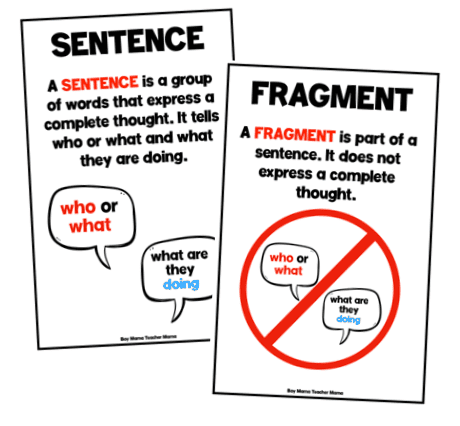
So, what do we know now? A sentence shares a complete thought, while a fragment gives us only part of that thought. And when we hear only a fragment, we usually know right away that something is missing.
For example, if I walked up to you and said:
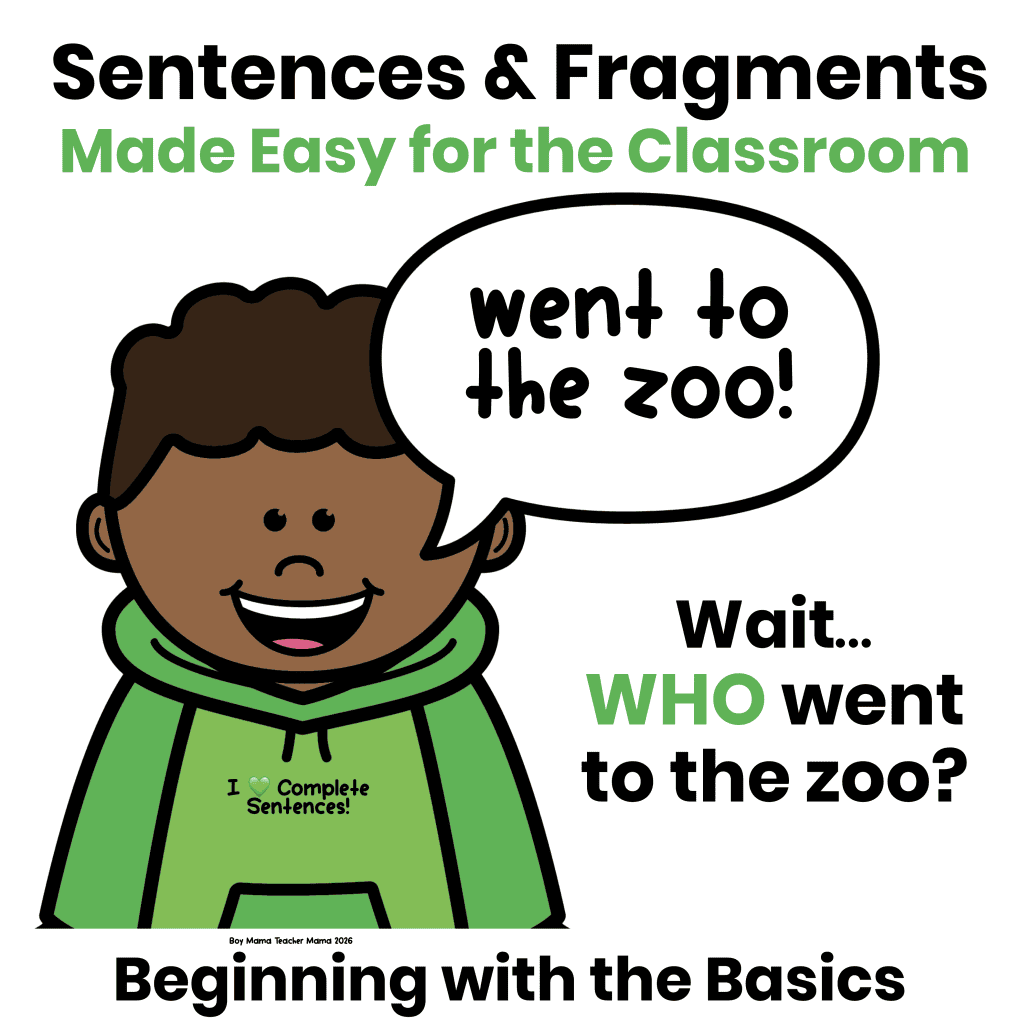
“Went to the zoo.”
You might look at me like I was crazy! Your first question would probably be, “WHO went to the zoo?”
Or what if I simply said:
“The sky!”
You’d probably respond, “What about the sky?”
In both examples, you were given only part—or a fragment—of a sentence. You know something is missing because you don’t have enough information to understand the complete thought.
What Happens Next?
So what happens from here? Kids aren’t suddenly going to start writing in complete sentences just because they understand what a sentence and a fragment are. They need practice recognizing what makes a sentence complete before we expect them to consistently write complete sentences on their own.
At this point, I focus on two things:
⭐️ Is it a sentence or a fragment?
⭐️ If it is a fragment, what is missing?
To figure out what’s missing, we start by looking for WHO or WHAT the sentence is about and what they are doing, feeling, etc.
Sorting Sentences and Fragments
I have a bunch of sentence strips—some with fragments and some with complete sentences. I tell the group that we’re going to sort them into sentences and fragments.
We read each strip together and decide where it belongs. Then we hang it on the board or glue it onto chart paper under the heading Sentence or Fragment.
And we don’t do this just once! This isn’t all taught and practiced in one day. Sorting sentences and fragments is just the first of several activities I use to help students really understand the difference between the two.
After students have gotten pretty good at identifying sentences and fragments, we move on to figuring out what is missing from the sentence.
Practicing Who/What and What Are They Doing/Feeling?
Now things get a bit trickier—not impossible, but our sorting takes on a different twist. This time, we take the strips with the fragments on them and do a deeper sort.
I put two new headings on the board:
WHO/WHAT
WHAT ARE THEY DOING/FEELING?
We read each fragment and decide what is missing. Then we place the strip under the heading that tells us which part we need to make it a complete sentence.
For example, if a strip says:
“They.”
I ask students, “What’s missing?” We know who the sentence is about, but we don’t know what they are doing or feeling. So, that strip goes under WHAT ARE THEY DOING/FEELING?
Or maybe a strip says:
“Can come too.”
This time, students should be thinking, “WHO or WHAT can come too?” We know what’s happening, but we don’t know who or what the sentence is about. That strip goes under WHO/WHAT.
Making Fragments Whole
This part just makes sense to me. It’s not necessarily something I teach right away, but kids enjoy it and it gives us a chance to put everything we’ve been learning into practice. We make the fragments whole by completing the sentence.
For example, we might go back to one of the fragments from our earlier sort and put it on the board:
“Can come too.”
Students come up with ideas for making it complete. They might say, “She can come too.” “They can come, too.” or even “The dog can come too.”
I add one of their ideas to our fragment and ask, “Is this a complete sentence now?” And, of course, they all cheer and say, “YES!”
Before we wrap up, though, we have one more step to take.
I explain that every complete sentence needs to begin with a capital letter and end with punctuation. We add those pieces to our newly completed sentences, and we’re ready to move on to our next sentence-level skill.
Give It a Try!
Before trying these activities with your students, give the process a try yourself! I created a simple FREE Sentences and Fragments activity that walks you through the same progression described above.
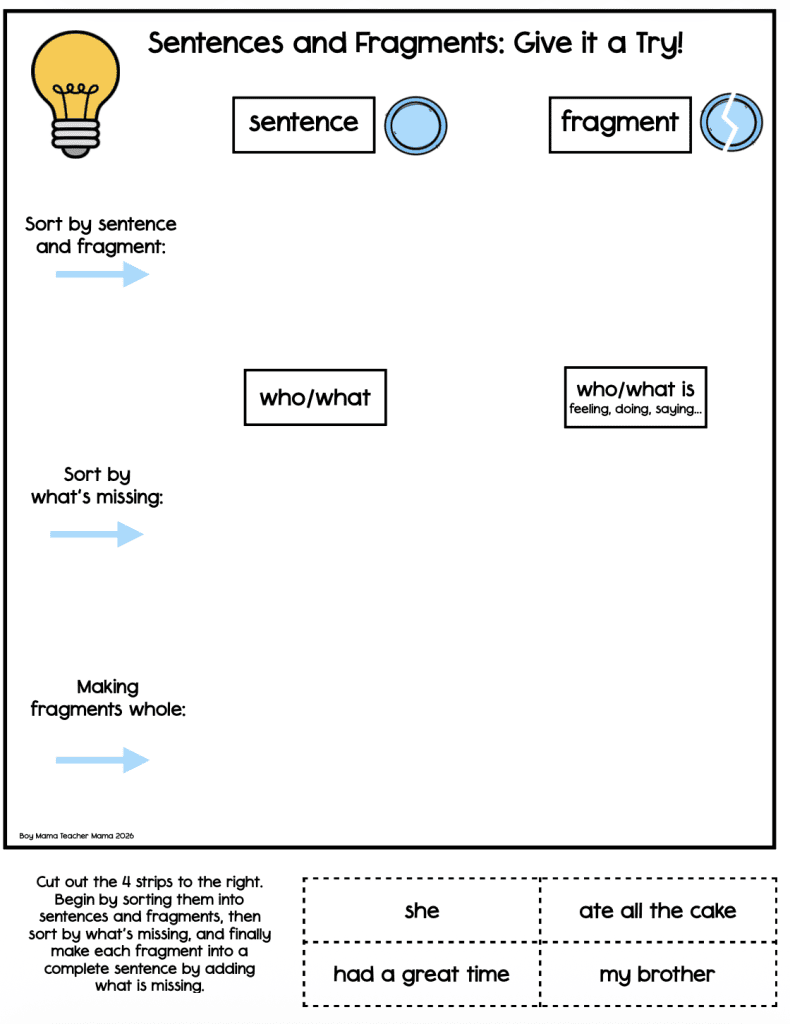
💚 Grab the FREE Sentences and Fragments Activity
Ready-to-Use Sentences and Fragments Activities
Want ready-to-use activities for teaching and practicing sentences and fragments? Try one of these:
Sentences & Fragments Sentence-Level Writing Skills Activities
This resource follows the same progression I shared in this post, with ready-to-use activities for introducing, identifying, sorting, and fixing sentences and fragments.
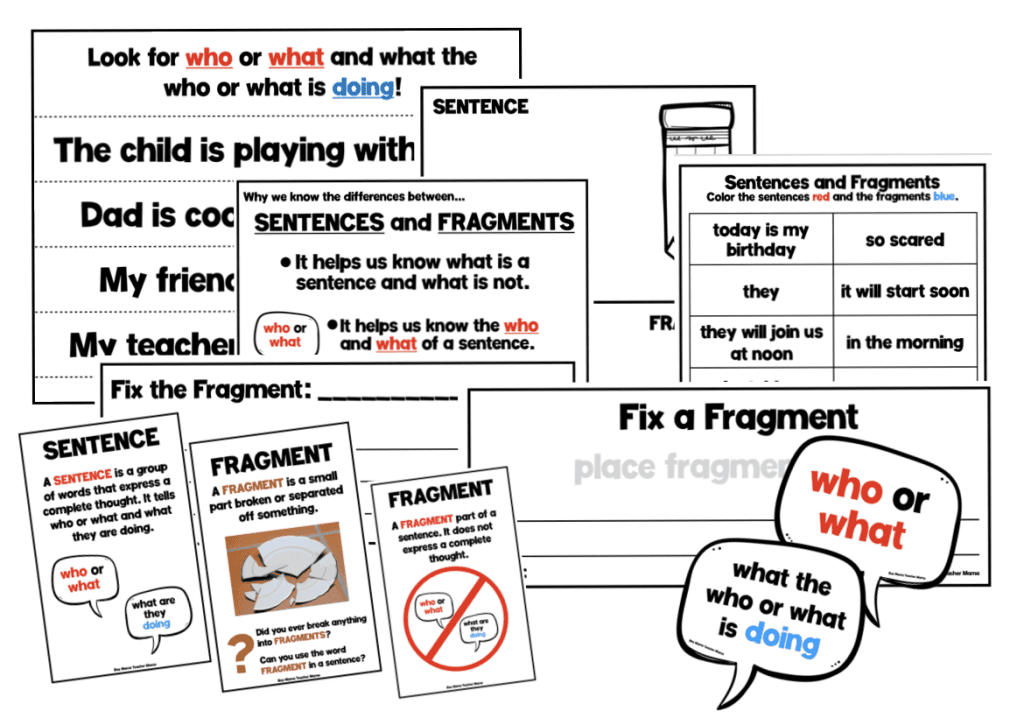
💚Grab Sentences & Fragments Sentence-Level Writing Skills Activities on TPT
Introducing Sentences & Fragments with Butterflies on the First Day of School
If you want to start slowly and simply introduce the skill, this resource pairs a great back-to-school book, Butterflies on the First Day of School, with group activities for exploring sentences and fragments.
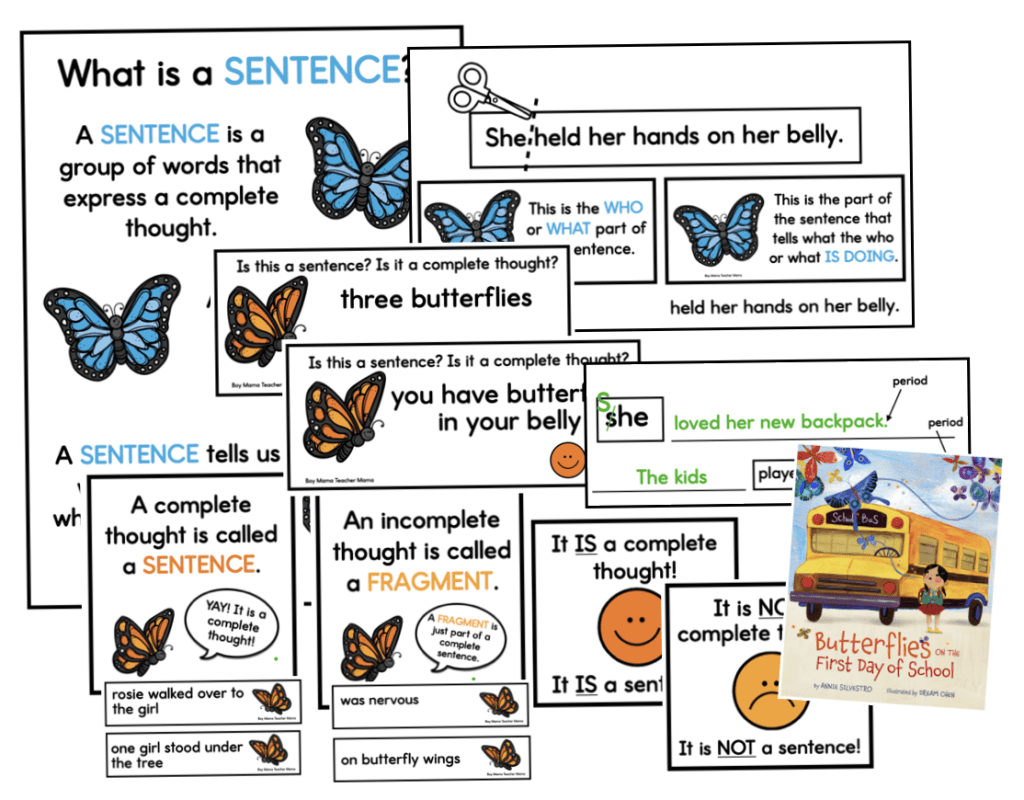
💚Grab Introducing Sentences & Fragments with Butterflies on the First Day of School on TPT
Sentences & Fragments with The Good Egg
If you want to take the skill further with a favorite read-aloud, this resource uses The Good Egg with group, partner, and independent activities for identifying, sorting, and fixing sentences and fragments.
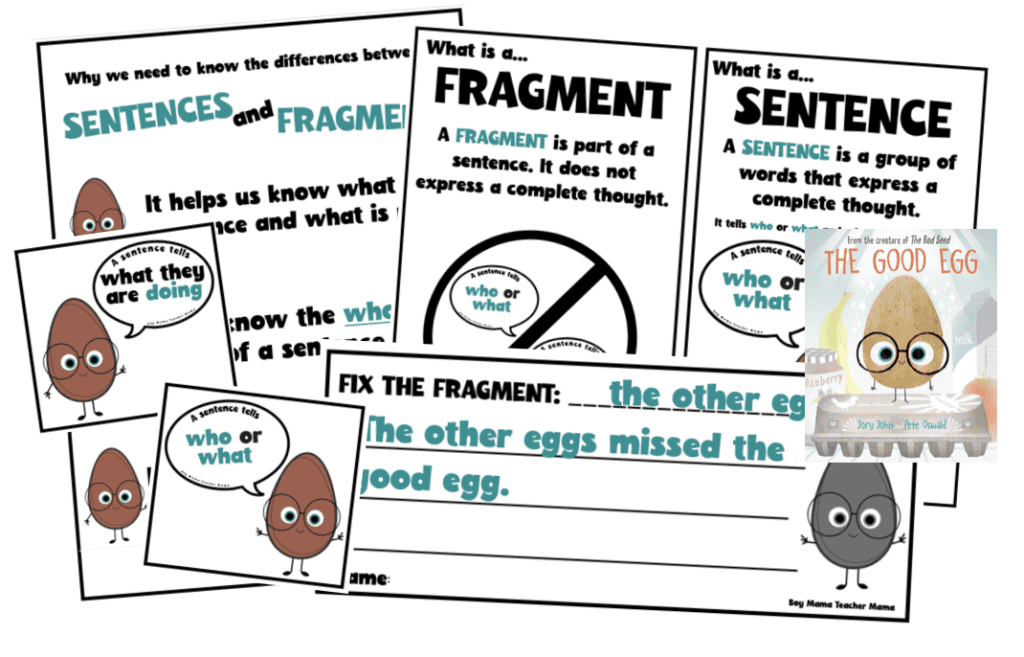
💚 Grab Sentences & Fragments with The Good Egg on TpT
Practicing Sentences & Fragments with Coyote
Once students understand the basics, this literature-based resource provides them with more practice with sentences and fragments using the book Coyote: A Trickster Tale from the American Southwest.
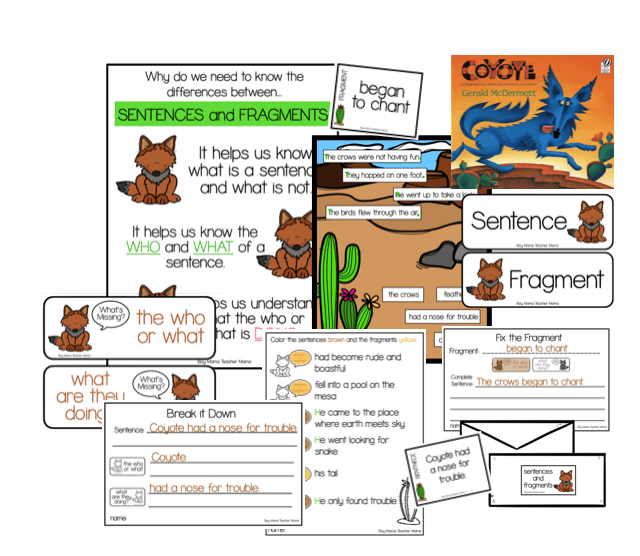
💚Grab Practicing Sentences & Fragments with Coyote on TPT
Building Writers One Step at a Time
Learning to recognize a complete sentence may seem like a small step, but it’s an important one. Before students can begin working with different kinds of sentences, asking questions, expanding sentences, or combining ideas, they need to understand when a sentence is complete—and when something is missing.
Give them plenty of time to practice. They don’t have to be writing perfect sentences yet. First, we want them to understand what makes a sentence whole.
Ready for the Next Step in Sentence Writing?
💚 Once students understand the difference between sentences and fragments, they’re ready to explore the four types of sentences! Check out my Four Types of Sentences post for more activities and ideas.

If this is your first time visiting Boy Mama Teacher Mama, welcome!
Did you know that you can also find us on Facebook, Instagram, Pinterest, and Teachers Pay Teachers?
© Boy Mama Teacher Mama 2026
All Rights Reserved