


Dice Games
📝 This post Dice Games, was originally published in 2012 and has been updated with new information and resources.
I have a huge collection of dice that once belonged in my classroom and now lives on a shelf in my basement. When my boys were little, I always carried a handful of dice with me to play while we waited at restaurants or the doctor’s office. I’d toss out a few dice and ask them to put the numbers in order, find matching numbers, make pairs with a certain sum, or even build with them. Those simple games kept them entertained while quietly building important math skills.
In the classroom, dice were an integral part of our everyday learning. We played many of the same games I used at home with my boys, but we also used dice to find partners, practice math facts, and even decide which game we would play during Morning Meeting. At the beginning of each school year, I loved showing my students my dice collection. Most of them had never seen a die within a die, a round die, or a die shaped like a top, and they couldn’t wait to try them all.
Now, as a substitute teacher, dice are still one of my favorite teaching tools. They’re always in my bag of tricks, and they work wonders whether I’m teaching kindergarteners or fourth graders. They’re inexpensive, incredibly versatile, and one of the easiest ways I know to turn learning into play.

Why Use Dice Games for Learning?
Dice are one of the simplest, most versatile teaching tools you can own. Because every roll produces a new result, they naturally encourage counting, comparing, computing, problem-solving, and critical thinking—all while keeping children engaged in a game rather than a worksheet.
Whether you’re teaching at home or in the classroom, dice can easily be adapted to practice dozens of different skills across multiple subject areas.
Using dice helps children:
✏️ Build number recognition and subitizing
✏️ Practice addition, subtraction, and multiplication
✏️ Strengthen counting skills
✏️ Develop probability and reasoning skills
✏️ Build reading and language skills
✏️ Stay engaged through hands-on, game-based learning
Best of all, dice are inexpensive, reusable, and endlessly adaptable. The same die can be used to practice a completely different skill simply by changing what’s written on each side.
Make Your Own Dice
One of my favorite things about dice is how easy they are to make yourself. Whether you’re creating a giant classroom die or customizing one for a specific lesson, homemade dice are inexpensive, fun to make, and often become students’ favorite learning tools.
Giant Die: Cover a box with solid-colored paper (wrapping paper works great), then cover it with clear contact paper. The contact paper lets you write on the die with a dry-erase marker or tape different learning materials to each side, so you can use it again and again.

Paper Dice Template: Print the template on cardstock, add dots, numbers, letters, pictures, or words to each side, then cut, fold, and glue it together. It’s an easy way to create a custom die for almost any lesson.
💚 Download a Paper Dice template here.
Die Within a Die: Place a smaller die inside a clear plastic cube and seal the edges with clear tape. Then glue parchment paper dots to the outside so it looks like one oversized die. Use it whenever you need to roll two dice at once for addition, subtraction, multiplication, or board games.

Endless Ways to Use a Blank Die
If you only own one specialty die, make it a blank or dry-erase die! I can’t think of another classroom tool that’s so easy to customize. Simply write on the sides with a dry-erase marker, and in seconds you’ve created a brand-new learning game.
Use it for math, reading, writing, science, social studies, classroom management, or just for fun. The same die can be used all year long by simply changing what’s written on each side.
Math Dice Ideas
🎲 Dot Die — Create a traditional die for counting, subitizing, and math games.
🎲 Numeral Die — Replace dots with numerals for number recognition and counting practice.
🎲 Number Word Die — Practice reading and recognizing number words.
🎲 Shape Die — Draw a different shape on each side. Roll, name the shape, or count its sides and vertices.
🎲 Fraction Die — Write fractions on each side for fraction recognition and comparison.
🎲 Fraction Picture Die — Draw fraction models for students to identify and name.
🎲 Operations Die — Write +, –, ×, ÷, and = on the sides. Pair it with numeral or dot dice to create endless math problems.
🎲 Coin Recognition Die — Tape coins (or pictures of coins) to each side. Roll and name the coin and its value.
🎲 Coin Value Die — Write coin values on each side and match them to the correct coin. Pair it with the operations die to practice adding money.
Language Dice Ideas
🎲 Sight Word Die — Practice reading high-frequency words.
🎲 Short Vowel Die — Write one short vowel on each side (using “your choice” on the sixth side). Pair it with consonant dice to build CVC words.
🎲 Long Vowel Die — Practice long vowel sounds the same way.
🎲 Consonant Die — Roll a consonant and combine it with the vowel die to blend and read words.
🎲 Word Family Die — Write a different word family on each side (-at, -it, -et, -ot, -ut, for example). Pair it with a consonant die to create and read new words.
🎲 Color Die — Color each side a different color for color recognition games.
🎲 Color Word Die — Practice reading color words.
Household Dice Ideas
Dice aren’t just for the classroom! They’re a fun way to add a little excitement to everyday routines at home.
🎲 Whose Turn Is It? — Let the die decide who goes first.
🎲 Household Chores — Roll to see who’s responsible for the next chore.
🎲 What Should We Do? — Fill the die with favorite family games or activities.
🎲 Snack Die — Let the die choose between healthy snack options.
🎲 Family Outing Die — Roll to decide where your next adventure will be.
🎲 Homework Die — Let the die decide which subject to work on first.
🎲 Movement Die — Fill each side with movements like hop, skip, twist, jump, spin, or dance for an instant brain break.
Quiet Dice Solutions
If you’ve ever listened to twenty-five students roll plastic dice at the same time, you know just how loud they can be! Thankfully, there are several easy ways to keep the fun while cutting down on the noise.
🎲 Dice in a Pringles Can — Line an empty Pringles can with felt, add the dice, and shake. It muffles the sound and doubles as convenient storage.

💚 Download the Dice Paper to cover your Pringles Can.
🎲 Magnetic Spice Container — Felt-lined magnetic spice containers make terrific mini dice shakers and store neatly on a magnetic surface.

🎲 Felt-Covered Plate — Cover a plate with felt to create a soft landing spot for rolling dice during centers or partner games.
🎲 Styrofoam Dice — Need an even quieter option? Styrofoam dice are lightweight, nearly silent, and perfect for classroom use. You can often find these at the Dollar Store!

FREE Dice Game
If you’re looking for an easy way to get started, this FREE Dice Game is a great place to begin! It includes three ready-to-use game boards plus one blank template so you can create your own version. Just print, grab a die, and you’re ready to play.
Students can play in several different ways:
🎲 Roll and Cover – Roll a die and circle the matching number on the game board.
🎲 Say It, Find It – One player says a number from 1–6, and the other player circles the matching die face.
🎲 Draw It – One player says a number from 1–6, and the other player draws the matching dot pattern on the blank die template.
These simple games build number recognition, subitizing, and matching skills while making great math centers, partner activities, morning work, or extra practice at home.

💚 Download the FREE Dice Games here.
More Dice Games and Activities
Once your students understand how to use dice, the possibilities are endless! Here are a few of my favorite classroom resources that turn simple dice into fun learning games.
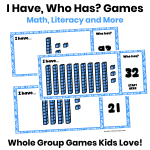
Counting Dice: I Have, Who Has?
This whole-group game is a classroom favorite for a reason. Every student gets a card, and the game keeps moving as students match dice patterns to continue the chain. It’s a simple, no-prep way to build counting fluency while keeping the entire class engaged.

💚 Grab Counting Dice: I Have, Who Has? on TpT.
Number Line Dice Games
This resource includes four differentiated dice games that use one, two, or three dice depending on students’ readiness. The included number line helps children visualize addition while strengthening number sense and computational thinking. They’re perfect for math centers, partner work, fast finishers, or extra practice.

💚 Grab Number Line Dice Games on TpT.
Number Sense Dice Games
This no-prep collection includes seven hands-on dice games that help students build number sense through drawing, tallying, writing, and adding. Just add one or two dice, print the game pages, and you’re ready to play!

💚 Grab Number Sense Dice Games on TpT.
Final Thoughts
If there’s one classroom tool I never regretted buying more of, it was dice.
They’re inexpensive, easy to store, incredibly versatile, and can be used to teach everything from counting and number sense to reading, spelling, probability, and even classroom routines. Whether you’re making your own giant die, creating a custom dry-erase die, or simply pulling a few dice out of your math tub, you’ll be amazed at how many meaningful learning opportunities can come from one simple cube.
I hope these ideas inspire you to look at dice in a whole new way. Happy rolling! 🎲

If this is your first time visiting Boy Mama Teacher Mama, welcome!
Did you know that you can also find us on Facebook, Instagram, Pinterest, and Teachers Pay Teachers?
© Boy Mama Teacher Mama 2026
All Rights Reserved


What a great list of ideas! I love your coin die. I have shared it on Google+.
Pingback: Boy Mama: How to Make a Giant Die from a Paper Carton | Boy Mama Teacher Mama