

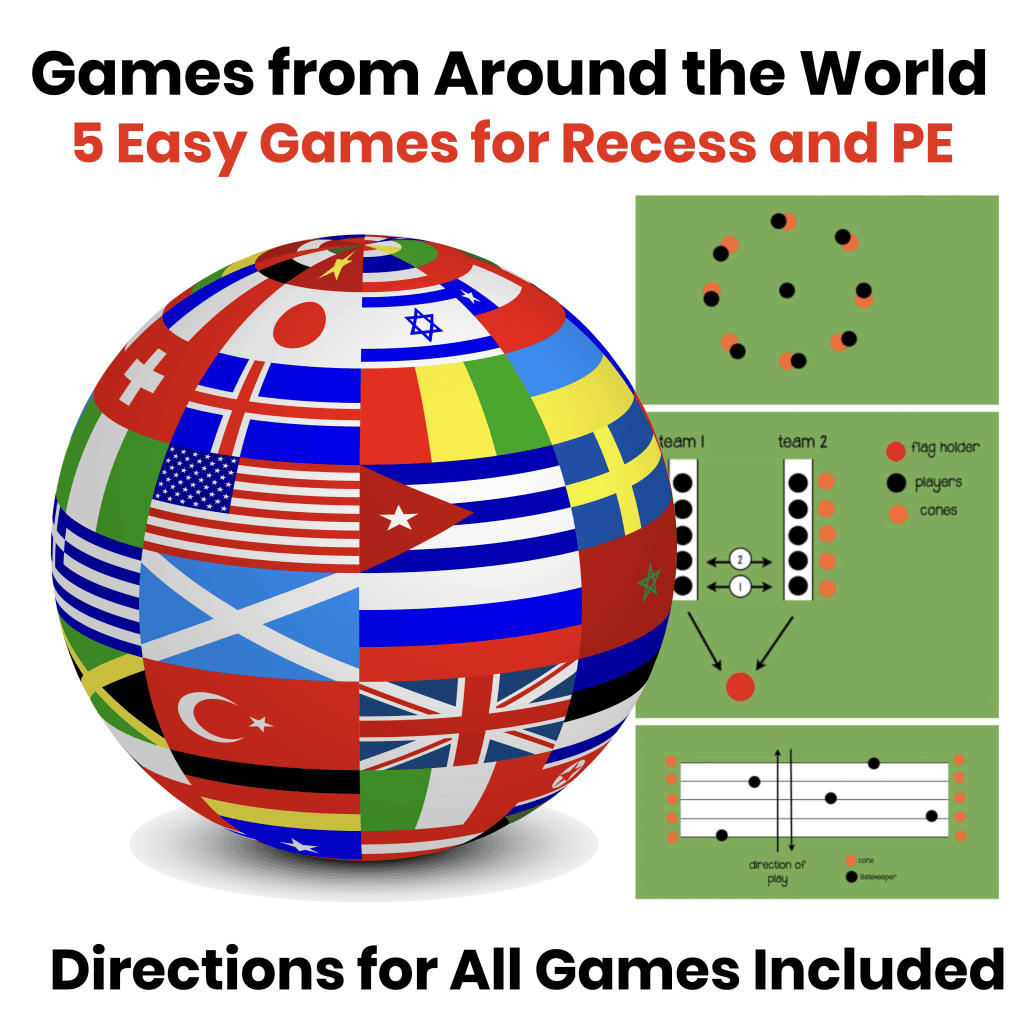
Games Around the World
📝 This post, 5 Fun Games from Around the World, was originally published in 2013 and has been updated with new information and resources.
One summer, I spent a week teaching children ages 3–12 games from around the world. We plowed through what seemed like hundreds of games, but there were a handful that really stood out and quickly became favorites.
These games require very little equipment and are great for recess, PE classes, summer camps, or simply getting kids outside and moving. Here are our five favorite games from around the world—campers included!
Hull i Hatten
From: Norway
Ages: 2nd Grade and Up
Equipment: One soft ball
Number of Players: Any size group
Translation: Hole in the Hat
How to Play
Players stand in a circle. Choose one player to be the “thinker.”
The thinker stands in the center of the circle, chooses a category (such as candy bars or sports), and secretly selects one item from that category. The thinker announces the category to the group.
The thinker tosses the ball to a player, who tries to guess the secret item. If the guess is incorrect, the player tosses the ball back to the thinker.
When someone guesses correctly, the thinker shouts, “Correct!” The player keeps the ball while everyone else runs away.
The player holding the ball shouts, “STOP!” Everyone freezes and forms a hoop with their arms.
The player with the ball takes three steps toward the closest player and tries to gently toss the ball through the hoop.
If the ball misses, the game begins again with the same thinker. If the ball goes through the hoop, the player who tossed it becomes the next thinker.
Suggestions for Play: Keep the categories simple and encourage students to make large hoops with their arms.
Luta de Galo
From: Brazil
Ages: 1st Grade and Up
Equipment: One handkerchief, bandana, or piece of cloth per player
Number of Players: Two or more
Translation: Fight of the Rooster
How to Play
Each player tucks a handkerchief or piece of cloth into their pocket or waistband, leaving enough fabric hanging out for another player to grab.
Players cross their right arm over their chest and stand on one foot.
Using only their left hand and hopping on one foot, players try to grab each other’s handkerchief while protecting their own.
The first player to grab their opponent’s handkerchief wins.
Suggestions for Play: Try playing with more than two children. When a player’s handkerchief is taken, they sit out until the next round. Play on grass or another soft surface with plenty of space.
Chinese Wall
From: England
Ages: 2nd Grade and Up
Equipment: Ten cones or chalk
Number of Players: At least ten
How to Play
Arrange ten cones in two rows to create five parallel lines across the playing area. Leave plenty of space between the lines.
Choose five players to be Gatekeepers. Assign each Gatekeeper to one of the parallel lines. Gatekeepers can only move from side to side along their assigned line.
The remaining players line up at the designated starting line. Their goal is to run to the opposite side of the playing area without being tagged by a Gatekeeper.
If a player is tagged, they become a Gatekeeper and join the line of the person who tagged them.
Players who make it across safely turn around and try to cross again in the opposite direction.
The game continues until only one runner remains.
Suggestions for Play: We played this game in both small and large spaces and found that the bigger the space, the better!

Bandiera
From: Italy
Ages: 1st Grade and Up
Equipment: A bandana, handkerchief, or piece of cloth
Number of Players: An odd number of players
Translation: Flag
How to Play
Choose one player to be the flag holder. Have them stand at one end of the playing area.
Divide the remaining players into two equal teams. Have the teams form two parallel lines facing the flag holder.
Assign each player on the first team a number. Repeat with the second team so that each team has a player with the same number. Players with matching numbers should stand across from one another.
The flag holder holds the flag in an outstretched hand and calls out a number. The two players with that number race toward the flag.
Both players try to be the first to grab the flag and return to their place in line without being tagged by the other player.
The flag holder calls another number, and the game continues.
Suggestions for Play: I found that using cones to mark where each player stands helped immensely. With older students, we kept score, awarding one point for returning safely with the flag or one point for tagging the player holding it. With younger students, we simply played for about 15 minutes without keeping score.


Odd One Out
From: Ireland
Ages: 1st Grade and Up
Equipment: Cones
Number of Players: One more player than the number of cones
How to Play
Arrange the cones in a large circle.
Choose one player to be the Odd One Out. This player stands in the middle of the circle while everyone else stands beside a cone.
The Odd One Out calls, “1, 2, 3!”
On “3,” everyone, including the player in the middle, races to find a different cone.
The player left without a cone becomes the new Odd One Out, moves to the middle of the circle, and begins counting.
Continue playing for an agreed-upon amount of time.
Suggestions for Play: Throw a little twist into the game by changing the directions. Here are a few we tried:
“You cannot run to the cone next to yours.”
“Hop to another cone.”
“Find a cone with someone who is wearing the same color as you.”

Original resources used when planning this camp included Ridgeway Primary’s Global Games and Passport to Games from Around the World. Unfortunately, the original online resources are no longer available at their original links.
Exploring Games From Around the World
One of the things I love about these games is how little equipment they require. A ball, a few cones, and some pieces of cloth can provide hours of fun while introducing children to games played in different parts of the world.

If this is your first time visiting Boy Mama Teacher Mama, welcome!
Did you know that you can also find us on Facebook, Instagram, Pinterest, and Teachers Pay Teachers?
© Boy Mama Teacher Mama 2026
All Rights Reserved


Hello! Thank you for the great game ideas! I would love to know a little more about the, Hull I Hatten game. Do you references on the history, of the game, the origin of how it started?
Thank you so much!
Catherine
[email protected]
Pingback: Norway | Use Resources Wisely
Pingback: World Thinking Day for Leaders: Italy | Use Resources Wisely
Pingback: World Thinking Day Ideas for Leaders: England (United Kingdom) | Use Resources Wisely
These would be great games for my VERY energetic younger siblings!
Great ideas for my when son’s group of friends are here! Keep them moving, taking and think in positive ways.
Let me know how it goes! Have a TON more if you are interested!
I teach world games in my PE classes…I would love new ideas if you have them…can’t seem to get on the Ridgeway Primary site…Mike Spiller Games of the World packets/website is an incredible resource I use too…
Have you checked out the blog, Kid World Citizen? They have some great resources!!!