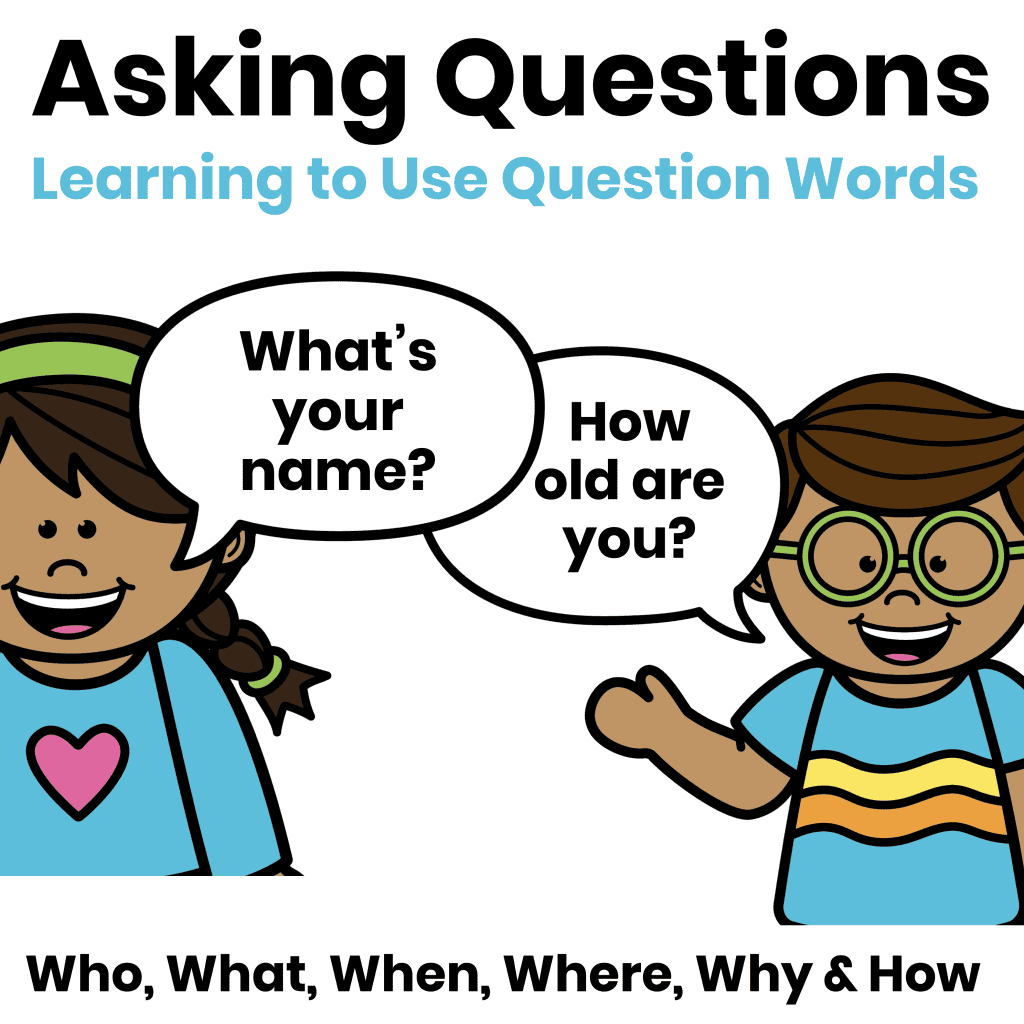
Our goal for young writers is to help them become confident writers who can easily express their ideas in writing. But before they can do that, students need to understand sentences. In this series, we’ll look at six sentence-level skills that help students become more effective writers. Our third skill is learning how to ask questions and use question words.
Understanding words like who, what, when, where, why, and how gives students the tools they need to ask for information, think more deeply, and write complete questions.
We ask questions all day long, and so do kids—ALL. DAY. LONG. The most common question, as you might imagine, is “When is lunch?” followed closely by “When is recess?”
These questions are good! Students are simply trying to gather information so they know what is going on around them and what to expect. Of course, they also ask questions about their work, changes in routine, what supplies they can use, and when they get to go home. And then there are those random questions that come up throughout the day like, “Did you know my dog has fleas?” All good. All about gathering information. 🙂
Asking questions is another skill we tend to take for granted because kids seem to “just know” how to do it. They’ve been asking questions since they learned their first words! But asking a clear question, choosing the correct question word, and being able to write a question is a different story. Those skills need practice.
It’s actually pretty interesting that each question word elicits a certain kind of response. You may think, “Well, duh!” but kids don’t necessarily know this. Up until this point, most of the questions they ask have been intuitive, not taught.
Just a Little Background Knowledge
Why is asking questions important?
⭐️ Makes students aware of their thinking
⭐️ Supports memory and retention of learning
⭐️ Allow students to apply knowledge
⭐️ Helps students gain a deeper understanding
⭐️ Helps students build connections
Ideally, if they are developmentally ready, students now know how to write a complete sentence and choose the correct ending punctuation. Oh, and let’s not forget that pesky capital letter at the beginning of a sentence that keeps rearing its head!
Now it’s time to help students understand how to use question words appropriately. As with the other sentence-writing skills, I begin with anchor charts, a brief discussion about the question words and what each one is asking for, and then plenty of practice.
Teaching Students to Ask Questions with Question Words
Some of you might not like the idea of anchor charts, and that’s fine. I find that they help me stay consistent with the language I use, and the simple visuals help younger learners understand and remember what each question word is asking for. We can also use the anchor charts when sorting questions and as a reference whenever students need them.
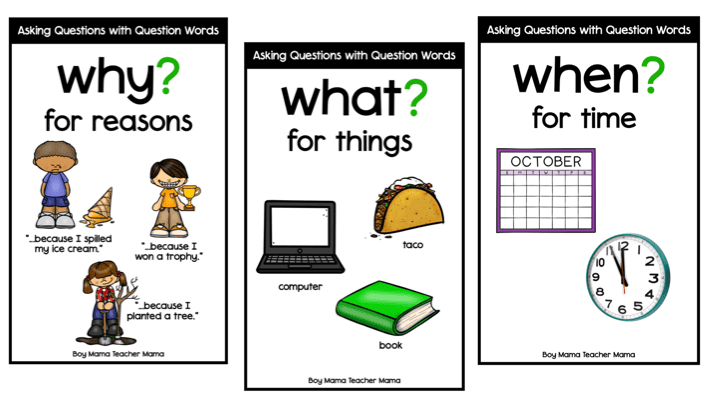
Remember, all this learning and teaching does not happen in one hour—or even in a day or a week. It takes repeated practice for students to become confident question askers.
With the anchor charts ready, I begin with photographs and one question word. I always start with the “easy” ones like who or where. We practice asking questions about the photos and don’t jump in with all six question words at once. Instead, I slowly add one or two at a time, usually leaving how for last.
For example, if we use the photo below, I might ask students to come up with a question using who, reminding them first that who asks us about the people (or things) in the photo. The photo can really be about anything, but tying it to your curriculum makes the activity even more useful.

Who is winning the race?
Who came in second place in the race?
Then I might ask students to use a different question word, such as why.
Why is the woman raising her hands in the air?
Why does the woman in yellow look sad?
As we share, I write the students’ questions on the whiteboard, modeling how to write a question correctly with a capital letter at the beginning and a question mark at the end. Students can share their questions with the whole group, in small groups, or during a turn-and-talk—all before it’s time for them to write.
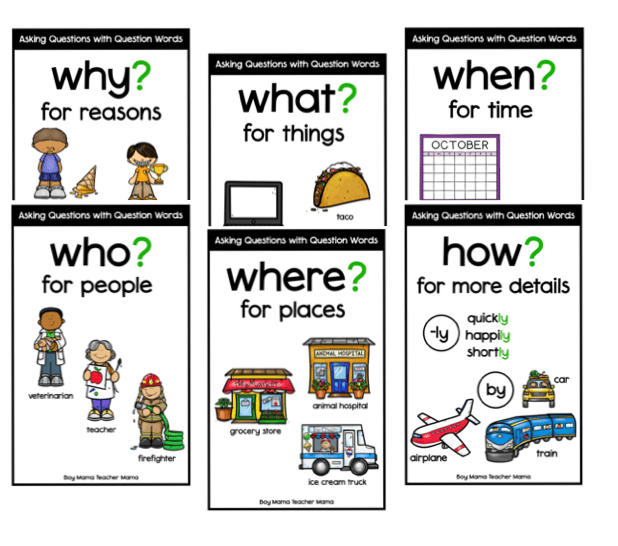
💚 Looking for Question Words Anchor Charts: Who, What, When, Where, Why & How? Grab them on TpT!
Writing Questions with Question Words
After plenty of oral practice and watching me model how to write questions, it’s time for students to begin writing their own questions using question words. This isn’t to say that students have never written a question before, but now it’s time for more explicit instruction.
When writing questions, we focus not only on choosing the correct question word, but also on writing a complete sentence with a capital letter at the beginning and, of course, a question mark at the end.
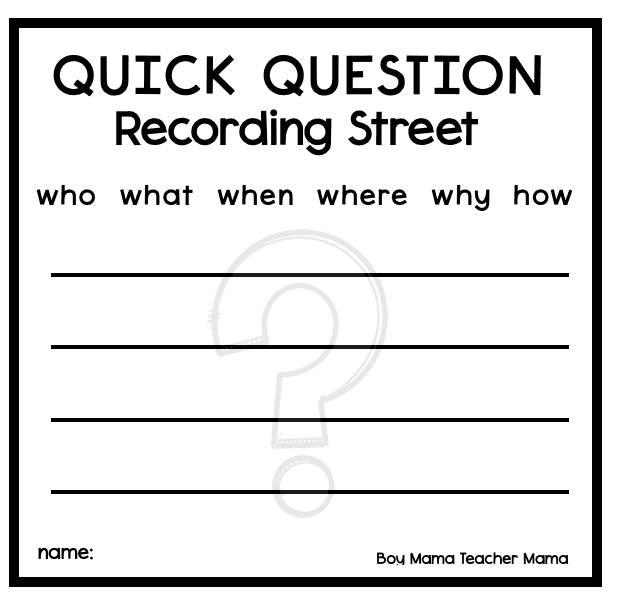
We practice writing questions with question words in a variety of ways, very similar to how we practiced writing different types of sentences.
Quick Questions: We simply stop what we are doing, and I ask students to write a question about anything using one of the six question words.
Quick Questions About a Photo or Illustration: Students write a question about a photo, like the one above, or an illustration in a book we are reading.
Quick Questions About a Topic, Event, or Issue: Students write a question about something we are studying, a current event, or an issue that has come up in our classroom, school, or the world.
Quick Questions About a Story or Article: Students write a question about something we are reading in class.
📝 Note: I call them “Quick Questions” because they aren’t something we spend a ton of time on. They’re also a great informal assessment, and the fun name makes it easy for kids to remember what we’ll be doing.
Writing Questions for Specific Answers
By now, I’m hoping my students are pretty good at asking and writing questions, but I have one more question word “skill” I want them to learn and practice. I call it Asking Questions for Specific Answers. This activity turns asking questions in a different direction.

We begin with one more review of the six question words and the kinds of answers each one helps us get. I display all six words on the board and bring out strips of paper with answers written on them—yes, answers, not questions!
I share an answer with the group—for example, “recess”—and ask which of the question words on the board could be used to write a question with the answer “recess.”
Students might suggest where, when, and what:
Where were you before lunch? Recess.
When did you hurt your knee? Recess.
What happens after lunch? Recess.
Then we repeat the activity with a handful of other “answers.”
This activity works especially well when connected to a unit of study! We did it during our study of meerkats, and I learned a lot—not only about my students’ understanding of question words, but also about how well they understood the content we had covered.
Ready-to-Use Asking Questions Activities
Want ready-to-use activities for teaching and practicing asking questions with question words? Try one of these:
Asking Questions Activities with Real Photographs
Real photographs give students something interesting to look at, think about, and discuss as they practice asking questions. This resource includes photograph discussion cards, question-word anchor charts, writing templates, and an Ask Away! board game. Students can practice asking questions orally before moving on to writing their own.
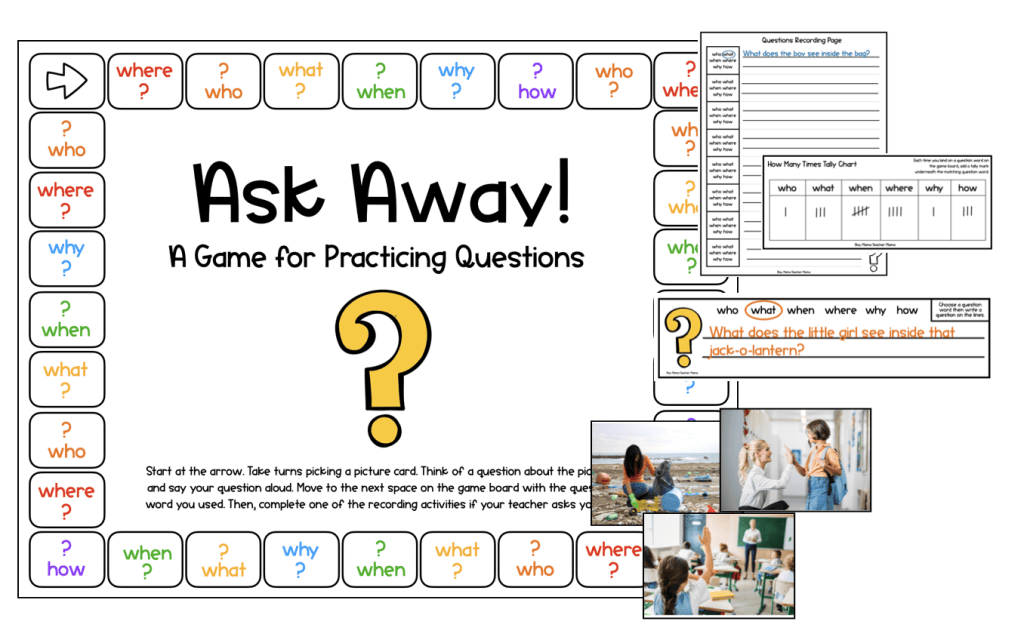
💚 Grab the Asking Questions Activities with Real Photographs on TpT
Asking Questions Activities
This resource follows the same steps shared in this post, with ready-to-use activities for introducing question words, choosing the correct question word, asking questions, and writing complete questions.
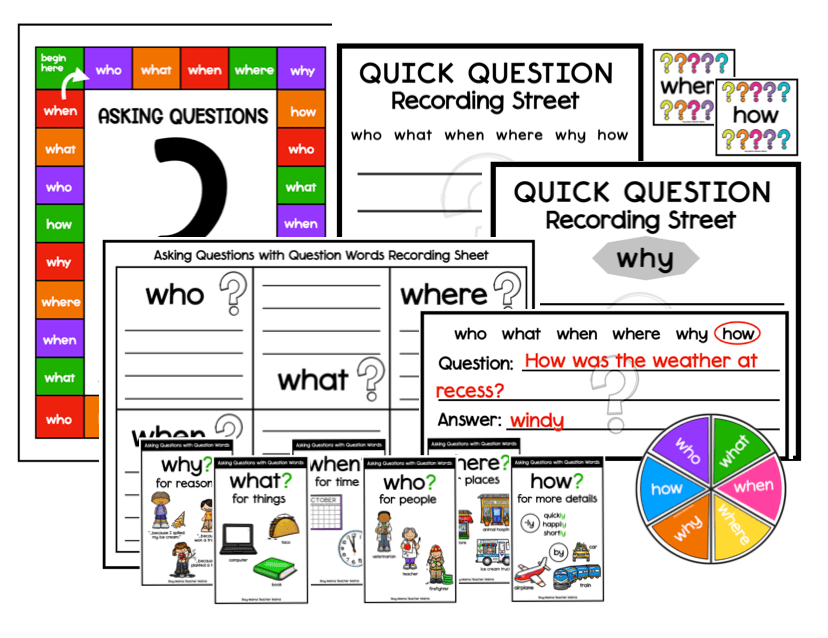
💚 Grab the Asking Questions with Question Words on TpT
Girl With Big, Big Questions Activities
This resource pairs The Girl with Big, Big Questions by Britney Winn Lee with simple activities for introducing question words and helping students understand what each question word is asking for.
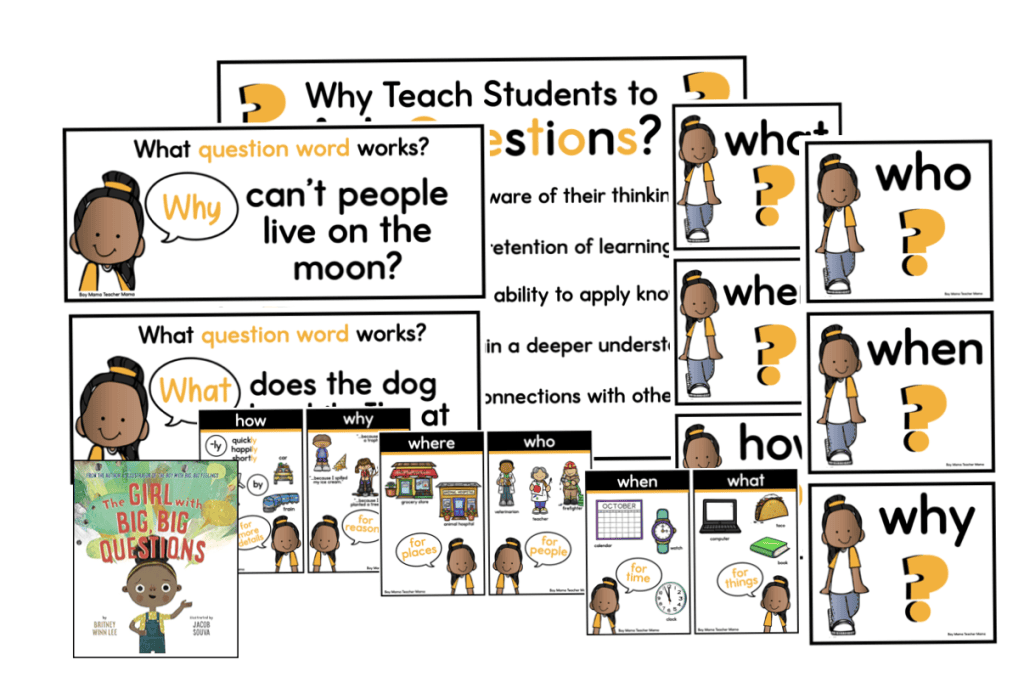
💚 Grab the Girl With Big, Big Questions Activities on TpT
Monkey Question Word Activities
Question word activities based on the trickster tale Monkey: A Trickster Tale from India by Gerald McDermott, giving students practice choosing and using question words to ask questions.
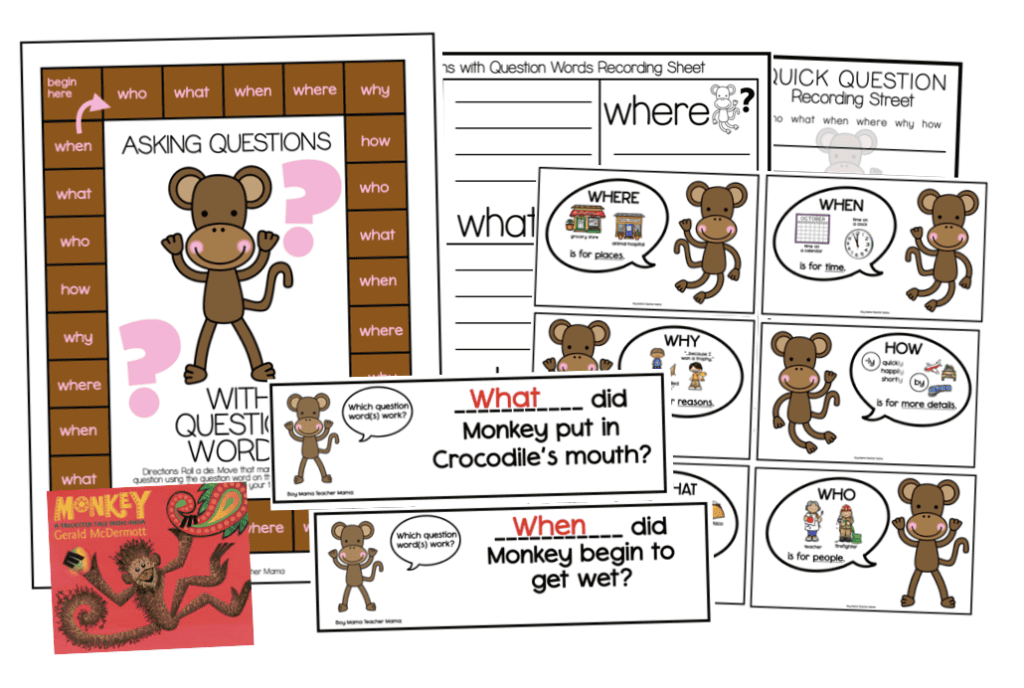
💚 Grab the Monkey Question Word Activities on TpT
The Sour Grape Question Word Activities
Question word and sentence-writing activities that pair with The Sour Grape and give students practice asking and writing questions.
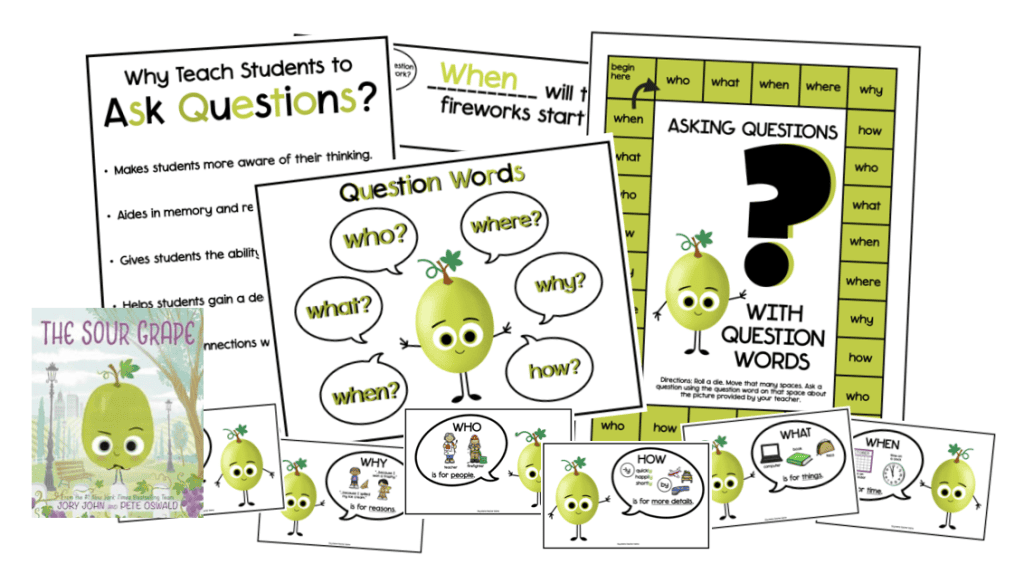
💚 Grab The Sour Grape Question Word Activities on TpT
Books about Asking Questions
There are also some wonderful picture books that get kids thinking, wondering, and asking questions. Here are a few that work especially well alongside this kind of instruction:
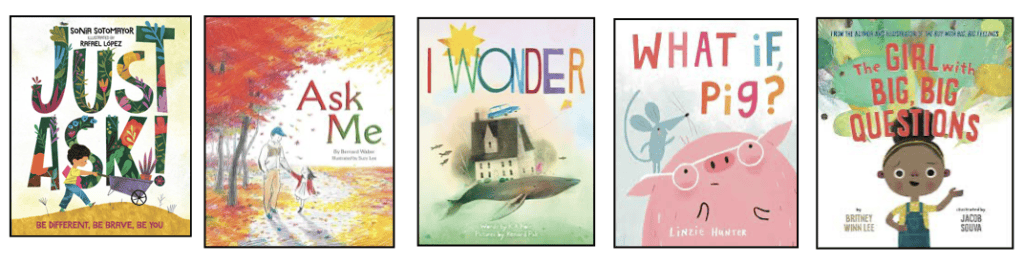
Just Ask by Sonia Sotomayor
Justice Sonia Sotomayor draws on her childhood with diabetes to celebrate kids of all abilities, as friends build a garden together and learn from their differences. #1 NYT bestseller.
Ask Me by Bernard Waber
A father and daughter trade questions on a walk through their neighborhood — a quiet story about connection and curiosity.
I Wonder by K.A. Holt
Kids wander through their day asking questions only children think to ask, like what clouds taste like. A celebration of seeing the world with fresh eyes.
What if, Pig? by Linzie Hunter
Pig’s a champion worrier. Planning a party for his best friend Mouse sends his “what if” thoughts spiraling — until Mouse helps him see things differently.
The Girl with Big, Big Questions by Britney Winn Lee
A curious girl asks the world big questions — even when it makes others uncomfortable. She learns that asking is how we grow.
Building Writers One Step at a Time
Learning to ask questions is another important part of becoming a strong sentence writer. Students need to learn how to choose the right question word, compose a complete question, and write it correctly. Starting orally, modeling along the way, and slowly moving into writing gives students time to put all those pieces together.
And remember, this isn’t a one-and-done lesson. Keep coming back to question words throughout the day and across the curriculum. Before long, those “Quick Questions” really will be quick and correct! 💚

If this is your first time visiting Boy Mama Teacher Mama, welcome!
Did you know that you can also find us on Facebook, Instagram, Pinterest, and Teachers Pay Teachers?
© Boy Mama Teacher Mama 2026
All Rights Reserved