
Diwali Activities for the Classroom
Have you ever been to a Diwali celebration? I’ve been fortunate enough to attend two in my lifetime. They were similar celebrations, but not exactly the same. The foods varied slightly, as did some of the traditions. The way people dressed and the Diwali activities they participated in were similar, but again, not quite the same.
I’m emphasizing similar, but not the same for a very specific reason.
I’ve been doing quite a bit of research on Diwali or Deepavali, and one thing that really stood out to me is how a single festival can be celebrated in so many different ways. Across countries, cultures, communities, and families, people celebrate Diwali with traditions that share common elements but also reflect their own histories and customs.
As I read and read and read some more about this Festival of Lights, I came to feel strongly that Diwali is not simply what some people call “the Indian Christmas.” It has its own history, colors, traditions, and stories. Trying to simplify it by comparing it to another holiday doesn’t do Diwali justice.
Finding the Meaning Behind Diwali
As I was reading and planning the resources I wanted to create, I had to figure out what message I wanted my students to walk away with.
There is so much happening during Diwali, and as I’ve mentioned, traditions vary greatly. I wanted to find the common threads that run through the different ways this holiday is celebrated.
Here’s what I discovered. And remember, I’m not an expert! I’m just a teacher who wants to introduce my students to Diwali and have them walk away with something meaningful to share with others. I want them to understand more than just the fact that people light candles and create colorful designs on the ground.
So, after all my reading and research, these are the ideas I decided to emphasize:
Diwali is a Festival of Lights. The name comes from a Sanskrit word meaning “row of lights.”
Diwali celebrates the triumph of good over evil, light over darkness, and knowledge over ignorance.
Stories are an important part of Diwali. The stories and their meanings vary across religions, regions, and communities.
Family and friends are an important part of many Diwali celebrations. Spending time together, sharing food, and celebrating with loved ones are common traditions.
Diwali represents new beginnings. For some communities, it also marks the beginning of a new year.
Diwali is rich in traditions, foods, colors, and history. How people celebrate depends on their families, communities, and cultural backgrounds.
Teaching Kids About Diwali
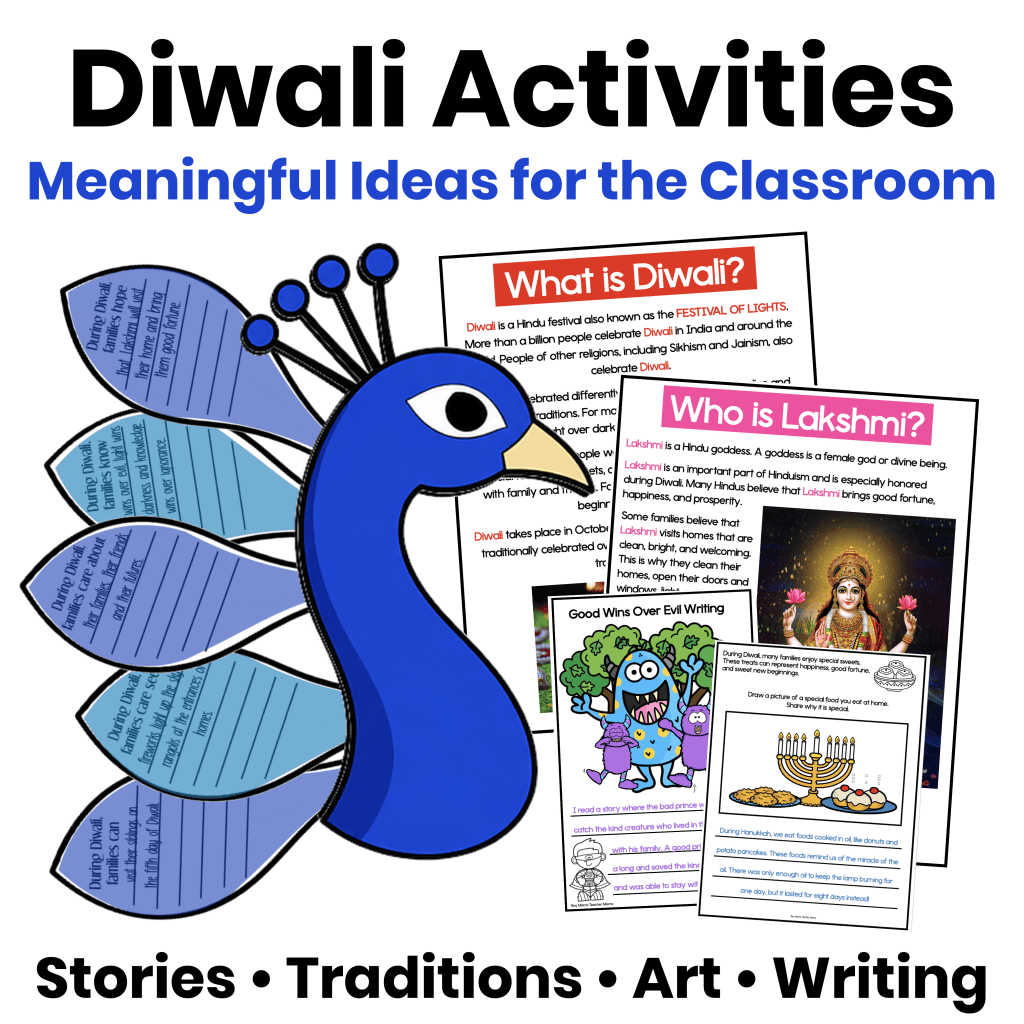
With my goals in mind, I set out to create a resource I could use in my classroom that would accomplish just that.
I began by introducing Diwali and finding out what my students already knew. Honestly, very few students knew much about it, and many hadn’t even heard of the celebration! That always makes my job more fun because I get to teach them something new and, hopefully, do it well enough that it sticks!
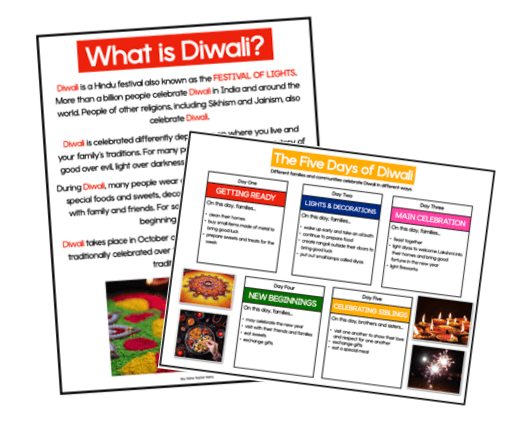
We talked about the meaning of the holiday and discussed what typically happens during the five days of the festival, keeping in mind that traditions vary among families and communities.
Diwali Stories and Traditions
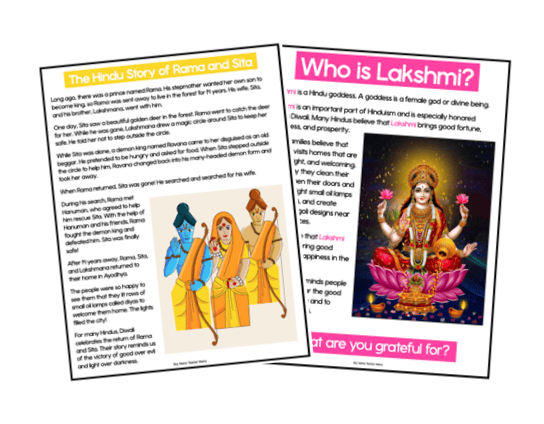
I introduce my students to Lakshmi, the Hindu goddess of wealth and prosperity. We talk about why she is important to Diwali and how many families clean and decorate their homes to welcome her and invite good fortune and prosperity in the coming year.
I introduce my students to Lakshmi, the Hindu goddess of wealth and prosperity. We talk about why she is important to Diwali and how many families clean and decorate their homes to welcome her and invite good fortune and prosperity in the coming year.
We also explore three different stories associated with Diwali. One of the most widely known is the story of Rama, Sita, and Lakshmana, who returned to their home in Ayodhya after 14 years of exile. According to the story, the people welcomed them home by lighting rows of small oil lamps called diyas.
We also read the stories of Vishnu and King Bali, and Lord Krishna and Narakasura.
What’s particularly interesting is that these stories are associated with different regions and traditions. The story of Rama’s return is especially important in northern India, while the story of Krishna and Narakasura is emphasized in many southern Indian celebrations. The story of Vishnu and King Bali is associated with celebrations in western India.
These stories help students understand the different meanings associated with Diwali, including the triumph of good over evil. The story of Vishnu and King Bali also introduces ideas about keeping promises, generosity, and humility.
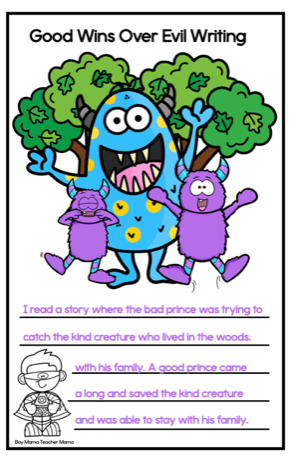
Good Over Evil Writing Activity
These wonderful stories lead us into some personal writing about a time when we’ve experienced good winning over evil in our own lives, or in books we’ve read, movies we’ve seen, or even games we’ve played.
Diwali Art Activities: Colors, Rangoli, and Diyas
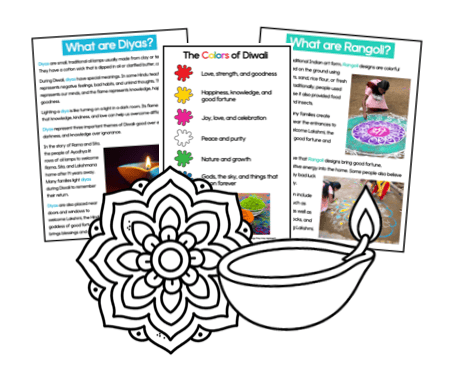
Next, we move on to colors. The colors used in Diwali celebrations are often chosen with purpose, and many have special meanings. Again, those meanings may vary among families and communities, but there are some common themes.
I felt it was important for students to understand the colors they would be using in the art activities we were about to do. We explored which colors are commonly associated with Diwali, what they can symbolize, and why we might choose certain colors for our artwork.
Next, we learned about two symbols commonly associated with Diwali: rangoli and diyas.
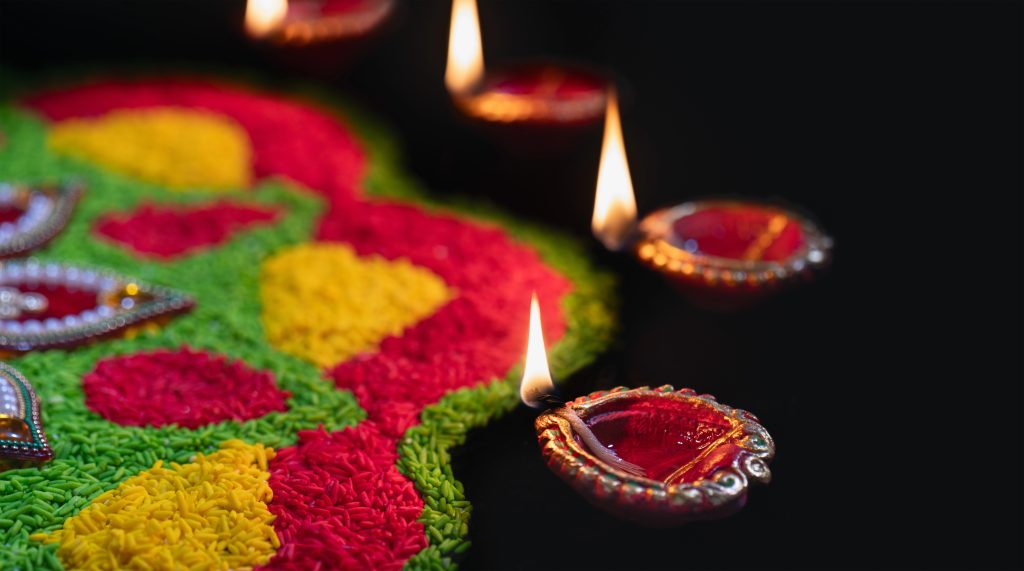
Rangoli are colorful, decorative designs often created near the entrances of homes to welcome guests and, in some Hindu traditions, Lakshmi, the goddess of wealth and prosperity.
Diyas are small oil lamps lit during Diwali, symbolizing light overcoming darkness and knowledge overcoming ignorance. But their meaning goes even deeper. In some Hindu teachings, the oil represents negative feelings, bad habits, and unkind thoughts. The wick can represent our inner selves, while the flame represents knowledge and goodness. As the oil burns away, it symbolizes letting go of negativity and allowing knowledge and goodness to shine.
Students created their own rangoli designs using one of the three options I provided. They also designed their own paper diyas. Before beginning either activity, we discussed the meanings and traditions behind these symbols so students understood the significance of what they were creating.
Diwali Food and Family Traditions
Before moving on to our final reflection, we had to talk about food!
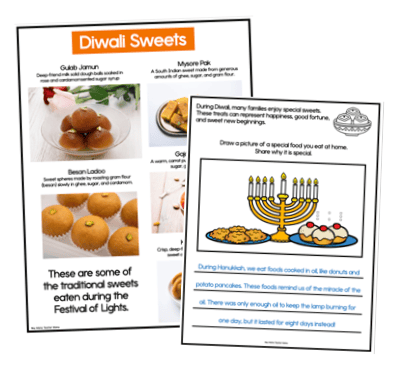
Food is an important part of so many traditions around the world, and Diwali is no exception. Students are introduced to a few of the sweet treats commonly enjoyed during Diwali celebrations. Then, they’re invited to make a personal connection by writing about a special food their family enjoys during a holiday or celebration at home.
Diwali Reflection Writing and Craft
Finally, students are asked to reflect on what they’ve learned about Diwali. My hope is that they can share some of their new knowledge and explain what stood out to them most about the celebration.
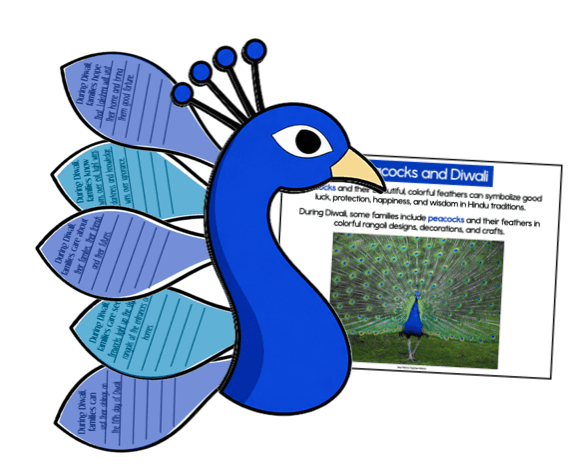
Finally, students are asked to reflect on what they’ve learned about Diwali. Each student receives five peacock feathers, each with a different writing prompt, such as “During Diwali, families can…” or “During Diwali, families hope…”
Students complete the prompts using what they’ve learned throughout the activities. They then attach their feathers to a peacock head, color their peacock, and cut it out.
This activity makes a wonderful ending to our Diwali lessons while also serving as a great informal assessment of what students have learned.
Oh, and in case you were wondering, “Why a peacock?” I should mention that peacocks and their feathers hold special meaning in Hindu traditions. They are associated with good luck, prosperity, and beauty, and you’ll often see them featured in artwork and decorative designs during Diwali celebrations.
The resource also includes an optional writing extension and the ever-popular word search—Diwali style!
💚 Find the complete Diwali Activities resource in my TpT store!
More Diwali Activities for the Classroom
Here are a few more activities to explore with your students
FREE Diwali Resources
Digraphs for Diwali gives students some extra digraph practice while creating a colorful rangoli design.
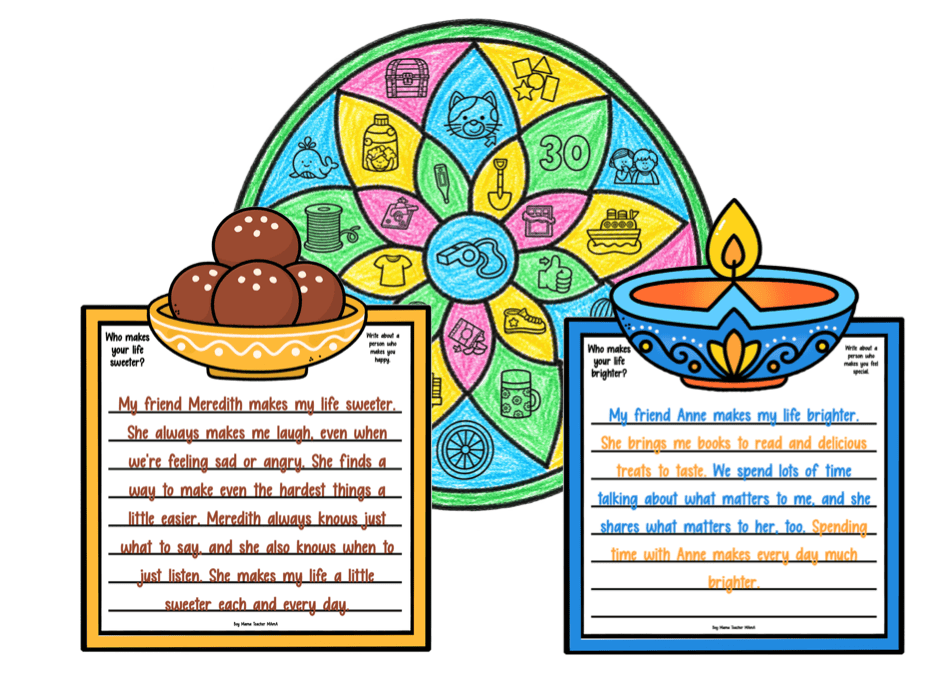
Diwali Writing Prompts includes two prompts: “Who Makes Your Life Brighter?” and “Who Makes Your Life Sweeter?” Both encourage students to think about the special people in their lives and make personal connections to the themes of light, happiness, and kindness.
💚 Grab the free Diwali activities from our FREE Resources Library!
Diwali Math and Literacy Activities
If you’re planning to spend a little more time learning about Diwali, I have two other resources you might enjoy using with your students.
Diwali Rangoli Addition and Subtraction Coloring Pages
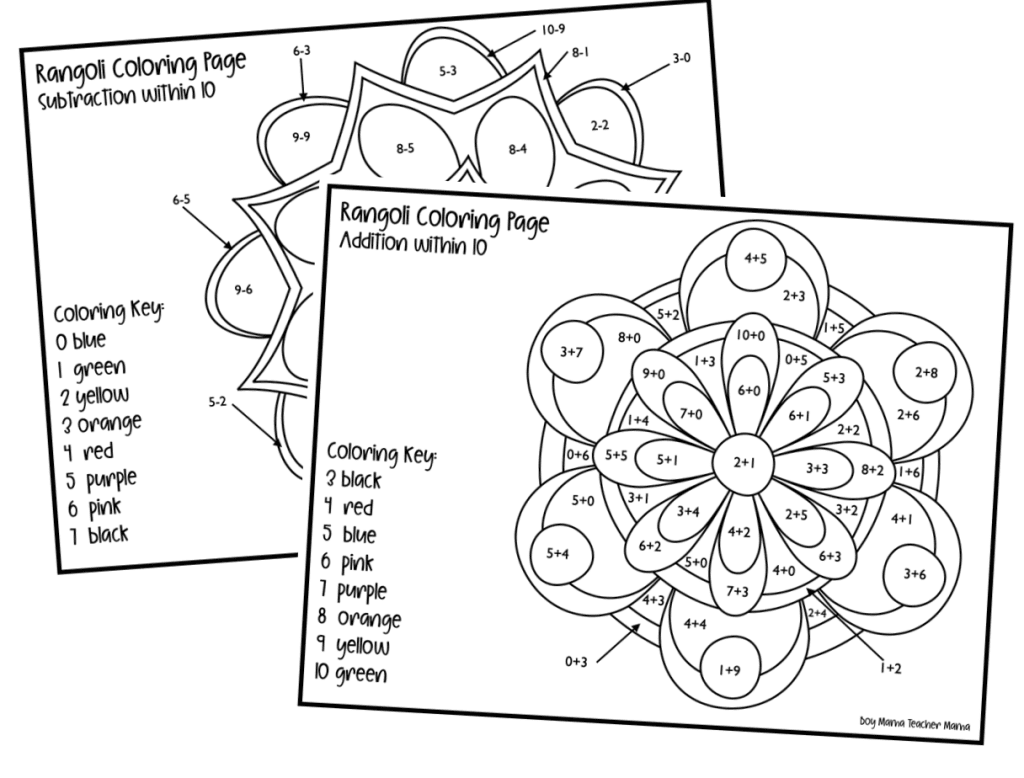
Why not bring a little Diwali into math time, too? These rangoli-inspired coloring pages give students practice with addition and subtraction within 10 while creating colorful designs.
💚 Grab the Rangoli Addition and Subtraction Practice Pages on TPT
Binny’s Diwali Sentence-Level Writing Activities
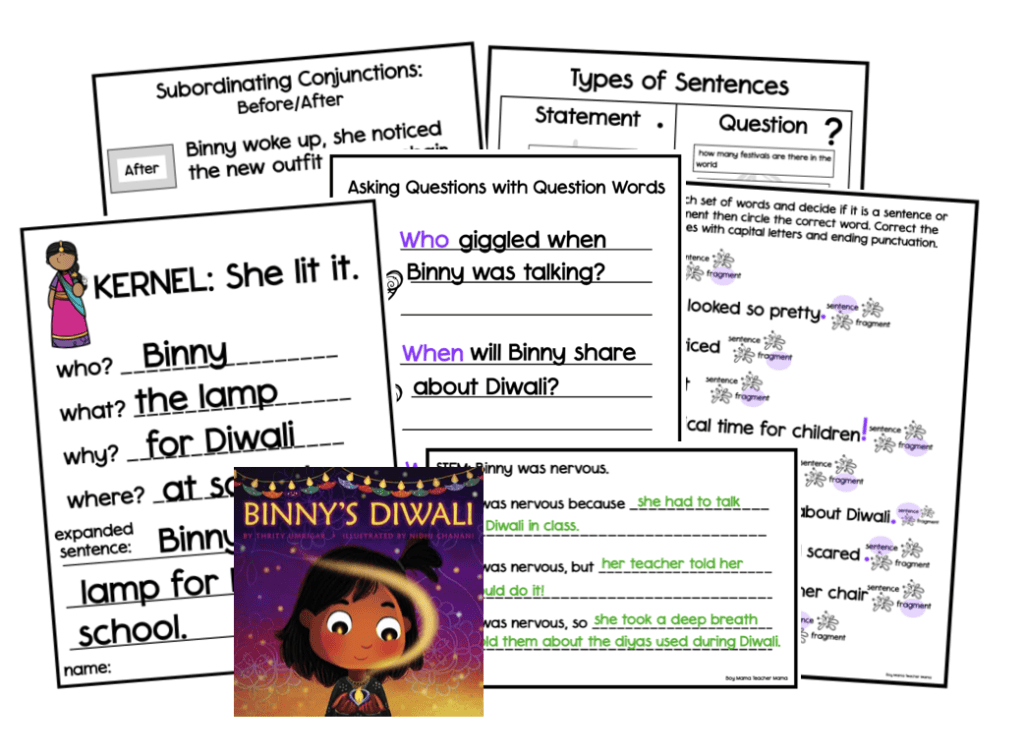
Binny’s Diwali by Thrity Umrigar is a wonderful book to share with students as they learn about the celebration. I’ve created a set of sentence-level writing activities to accompany the story.
💚 Grab Binny’s Diwali Sentence Level Writing Activities from TPT
Wrapping it Up
When I began creating these activities, my goal was to help students understand that Diwali is about so much more than lights, decorations, and delicious food. I wanted them to learn about the stories, traditions, and meanings behind the celebration while recognizing that not everyone celebrates Diwali in the same way.
Of course, there is so much more to Diwali than we can cover in a few classroom lessons. But I hope these activities give students a better understanding of this wonderful festival and an appreciation for the different ways people celebrate it around the world.
And if they walk away remembering a few new things about Diwali that they can share with someone else, then I think we’ve accomplished something worthwhile!

If this is your first time visiting Boy Mama Teacher Mama, welcome!
Did you know that you can also find us on Facebook, Instagram, Pinterest, and Teachers Pay Teachers?
© Boy Mama Teacher Mama 2026
All Rights Reserved