
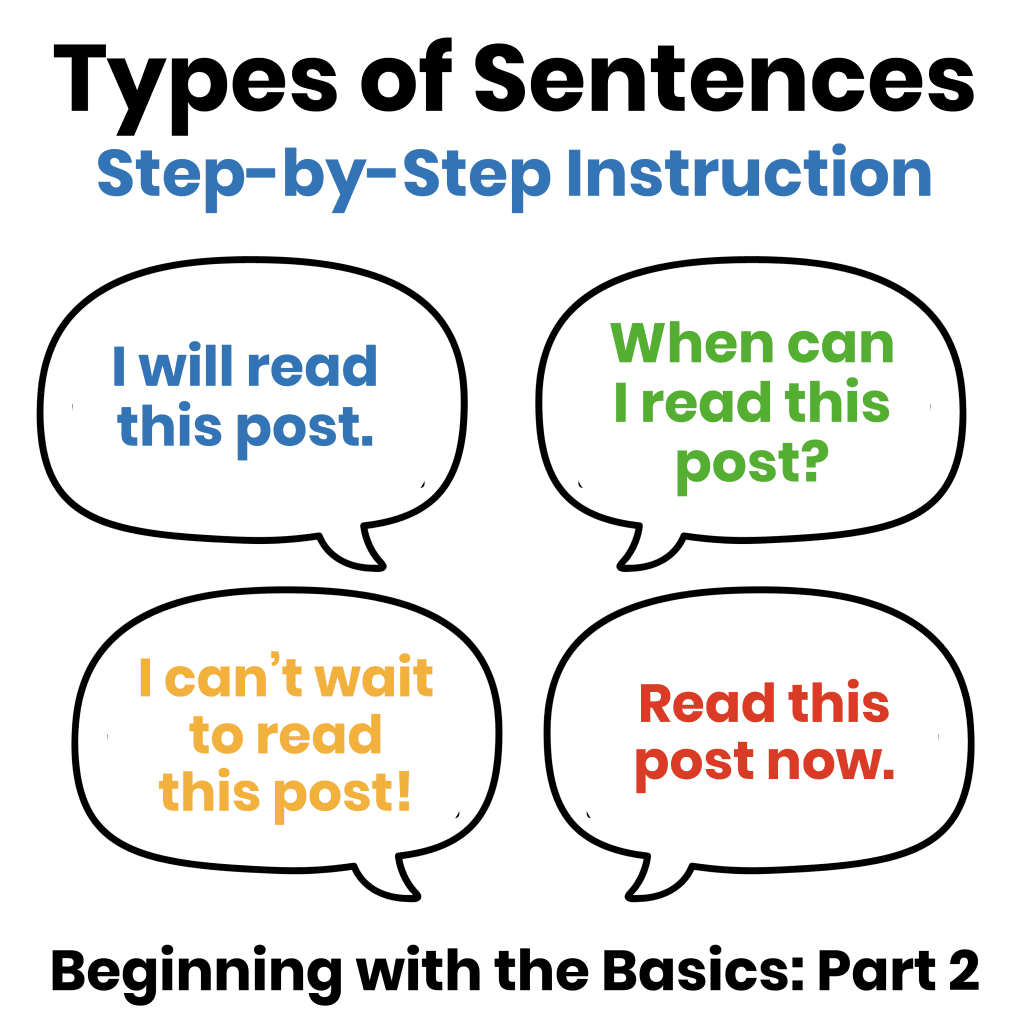
Our goal for young writers is to help them become confident writers who can easily express their ideas in writing. But before they can do that, students need to understand sentences. In this series, we’ll look at six sentence-level skills that help students become more effective writers. Our second skill is understanding and identifying the different types of sentences.
Now that students are comfortable with sentences and fragments, we are ready to move on to the different types of sentences. This is actually a really fun skill to teach because you get to be a little dramatic! It is also a skill you will almost immediately see showing up in your students’ writing. Now, whether they use it correctly or not is a different story. 🙂
Starting Out Simple
I always start simple—just statements and questions because those are the easiest for students to understand and the ones they use most often. Once students are comfortable with statements and questions, we add in exclamations and, later, commands because they are the trickiest of the four.
Teaching sentence types is actually pretty multidimensional. Students need to learn the name of each sentence type and what it means—statement, question, command, and exclamation—as well as the punctuation mark that goes with it. At the same time, we’re still reminding students that these need to be complete sentences and, of course, we have to throw in that fussy old capital letter at the beginning!
So, keeping all of that in mind, here’s what we’re working on as we learn about the different types of sentences:
✓ Sentence type and its meaning
✓ Punctuation mark and its meaning
✓ Complete sentences
✓ Capital letter at the beginning
There’s nothing better than an anchor chart to refer to while teaching types of sentences—well, any of these sentence-level skills, really! I have two that I use over and over.
One is better for introducing the different sentence types and teaching what each one means. The other is a simple quick-reference chart that I print and turn into a table tent for each student table.
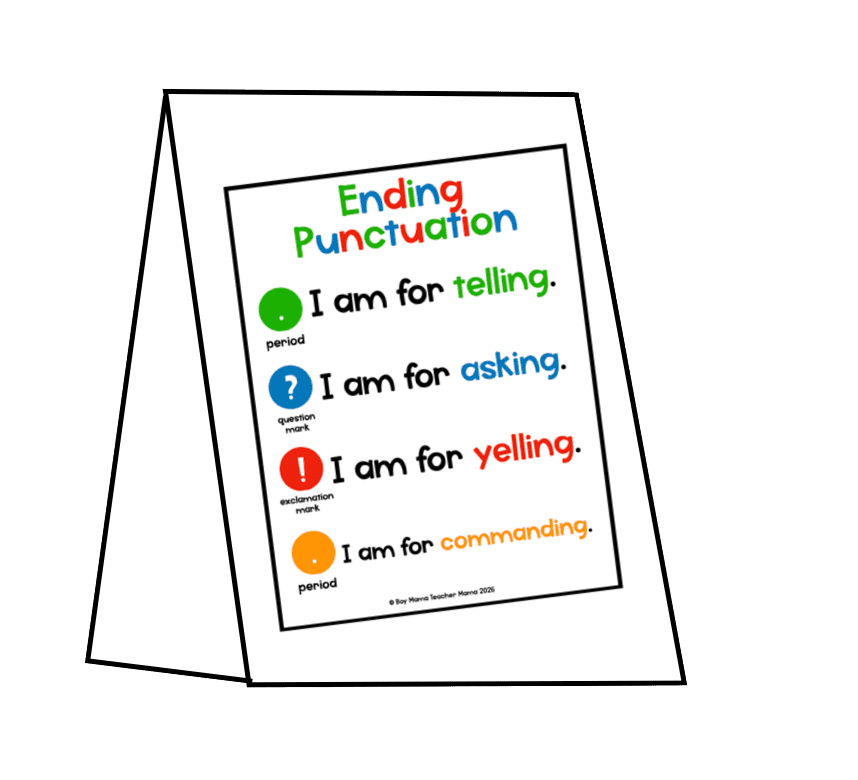
📝 Note: I realize this anchor chart is pretty basic and that we don’t always yell when we are exclaiming something! At this point, I simply want my students to understand that an exclamation point shows a lot of emotion. We’ll refine that understanding as we continue working with sentence types.
💚 These sentence type anchor charts are included in my complete Sentence Types resource.
Before we begin practicing, let’s take a quick look at each of the four sentence types and what each one means.
The Four Sentence Types
Statement: A statement is a type of sentence that shares a fact, idea, or opinion.
Question: A question is a type of sentence that asks for information.
Exclamation: An exclamation is a type of sentence that shows strong feelings.
Command: A command is a type of sentence that tells someone what to do.
Teaching Sentence Types Step by Step
We start by focusing mostly on the sentence types and their punctuation marks—and again, we get dramatic!! We talk about what a statement is and what a question is, as well as situations when we might use each type of sentence. During this time, I use my Sentence Types Teaching Sticks to help students make the connection between the sentence type and the punctuation mark that goes with it.
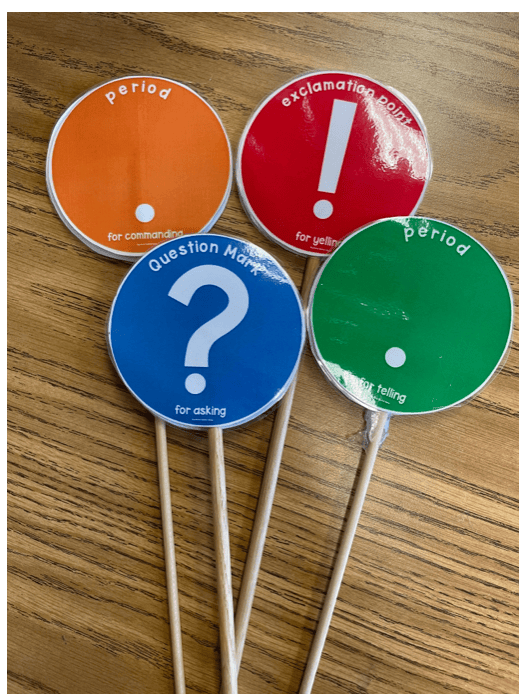
I have a bunch of sentence strips prepared with statements and questions (and later, exclamations and commands). We read through each sentence together and decide whether it is a statement or a question. Once the group has identified the sentence type, I hold up the corresponding teaching stick and say something like, “Yes! That is a statement, and we use a period at the end of a statement.”
Since we are doing all of this orally, we aren’t worrying about capital letters yet. For now, the focus is simply on identifying the sentence type and connecting it to the correct punctuation mark.
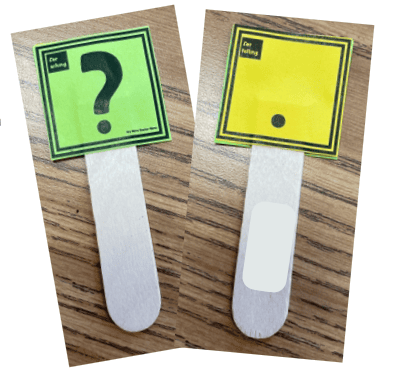
Once the group is comfortable with this, I give students mini response sticks. I read a sentence aloud, and students hold up the stick showing the correct ending punctuation. Then I ask them to name the punctuation mark they chose.
Adding Exclamations and Commands
Finally—commands. These can be tricky because they can sound like an exclamation, but they end with a period like a statement. That’s quite a lot to keep straight! With time and practice, though, students begin to understand the difference. And really, who doesn’t enjoy bossing others around and calling it learning? 🙂
Again, we follow the same steps as before, but I teach commands very explicitly because they are their own unique sentence type and can easily be confused with the others.
Once students are comfortable with commands, we begin mixing all four sentence types together. We continue using the same sentence strips and response sticks, but now students have to decide whether each sentence is a statement, question, exclamation, or command and choose the correct ending punctuation.
When students are comfortable identifying the four sentence types, we are ready to move from identifying sentences to writing them.
The Next Step: Writing Sentence Types
This is where the work we did with sentences and fragments meets the sentence types we are working on. Students are now being asked to write complete sentences using the correct ending punctuation while also remembering that pesky capital letter at the beginning.
This part is really all about practice—and I’m not talking about worksheet after worksheet. That kind of practice certainly has its place, just not all the time. There are so many easy ways to practice writing sentence types throughout the school day.
Ways to Practice Writing Sentence Types
Whiteboard Fixes: I often write a sentence on the board that is missing its ending punctuation and capital letter and simply ask a student to come up and fix it. You know kids love getting a chance to write on the whiteboard!
Morning Message: I also do the same thing with our morning message. The nice part about using the message is that as students read it when they get to school, they often start talking among themselves about what type of sentence it is and what needs to be changed or added before we even get to it as a group.
Everyday Writing: Anytime students are writing is a perfect opportunity to practice these skills—and a super easy way to differentiate for individual student needs. One student may still be working on remembering a capital letter and period, while another may be ready to experiment with questions or exclamations.
Quick Sentences: We also do Quick Sentences. I give students a “Quick Sentence” paper and a simple direction such as, “Write a question” or “Write an exclamation.” Then we share some of their sentences and use them to guide our discussion as needed. The actual writing takes maybe five minutes, although the sharing usually takes a little longer!
Practice Pages: Of course, there is a time and place for practice pages or worksheets, too—just not all the time. They are another way for students to practice identifying and writing the different sentence types independently.
Student Sentences: Students love writing things “wrong” and having a classmate correct them. This works really well with sentence types! I do have one expectation, though: the student creating the sentence has to write it correctly first. Then they write it incorrectly and give it to a classmate to fix. This way, I know the student creating the challenge understands the skill, too.
Picture Prompts: Have students look at a photograph or an illustration in a book and write four sentences about it—one of each sentence type. This is also an easy way to connect sentence practice to your current unit of study. Learning about pumpkins? Show students a photograph of people at a pumpkin patch and have them write a statement, question, exclamation, and command about the picture.
Games! Games! Games! Need I say more? Sentence type games are an easy way to get in lots of extra practice without pulling out another worksheet.
Try Quick Sentences with Your Students
Quick Sentences are one of the easiest ways to squeeze sentence-writing practice into the school day. Give students a sentence type, have them write one sentence, and then share a few together. It only takes a few minutes!
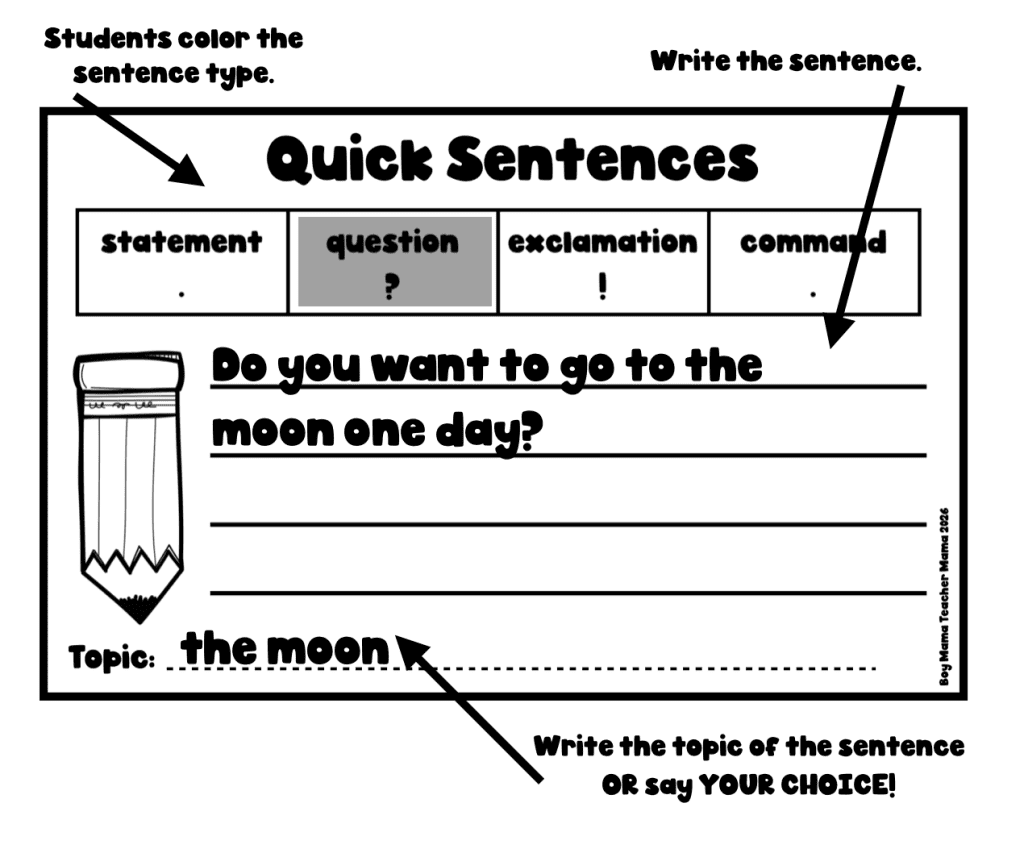
💚 Grab the FREE Quick Sentences template and give it a try with your students.
If you’re ready to take this same progression into your classroom, I have several sentence types resources that give students even more opportunities to practice.
Ready-to-Use Types of Sentences Resources
Types of Sentences: Anchor Charts and Sentence Writing Practice
This is the main resource that follows the progression shared in this post, taking students from learning and identifying the four sentence types to writing their own.
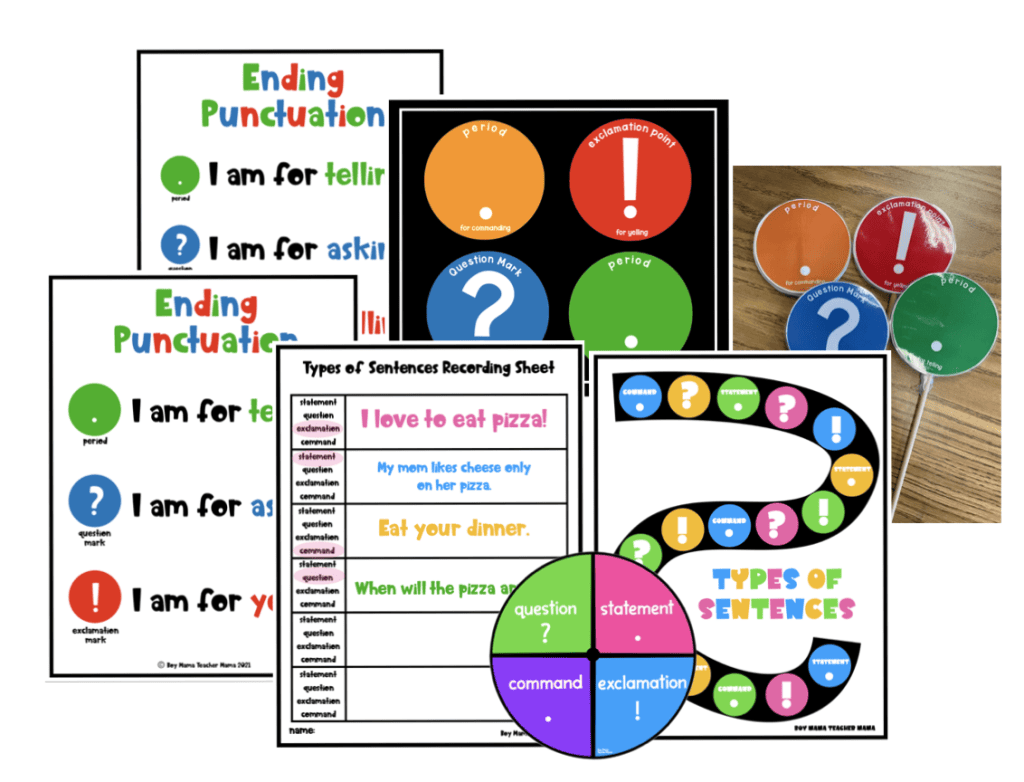
💚 Types of Sentences: Anchor Charts and Sentence Writing Practice
More Types of Sentences Practice with Books
Want even more practice? These book-based resources give students additional opportunities to work with sentence types through group, partner, and independent activities.
Types of Sentences with You Will Be My Friend!
For lots of additional practice, this resource pairs You Will Be My Friend! with group and independent activities for identifying and working with the four sentence types.
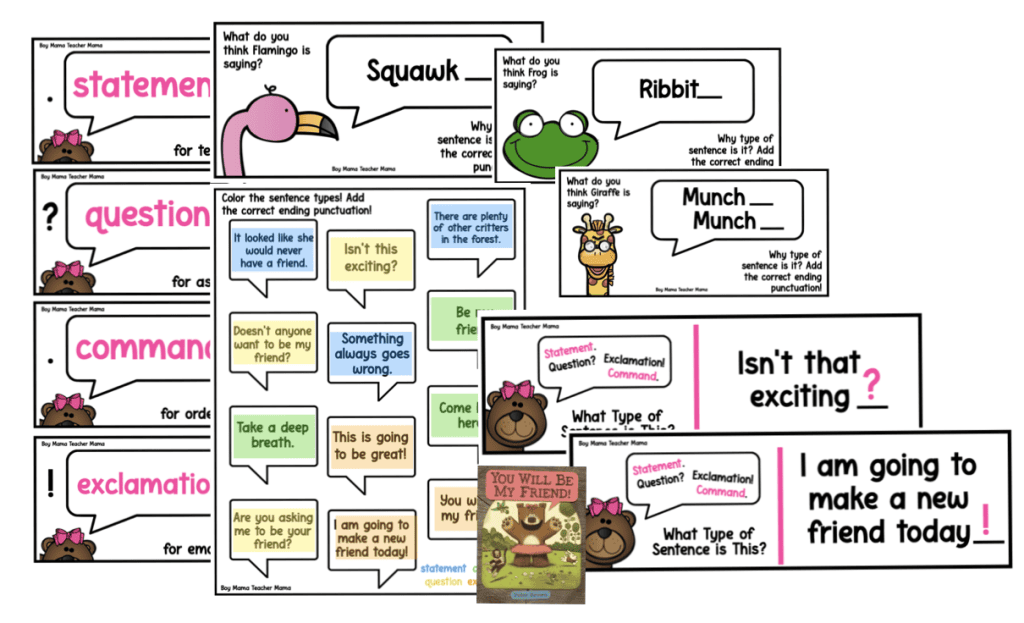
💚 Grab Sentence Types with You Will Be My Friend! on TpT
Types of Sentences with Papagayo
Bring sentence types into your read-aloud with Papagayo: the Mischief Maker. This resource gives students additional practice identifying and working with statements, questions, exclamations, and commands.
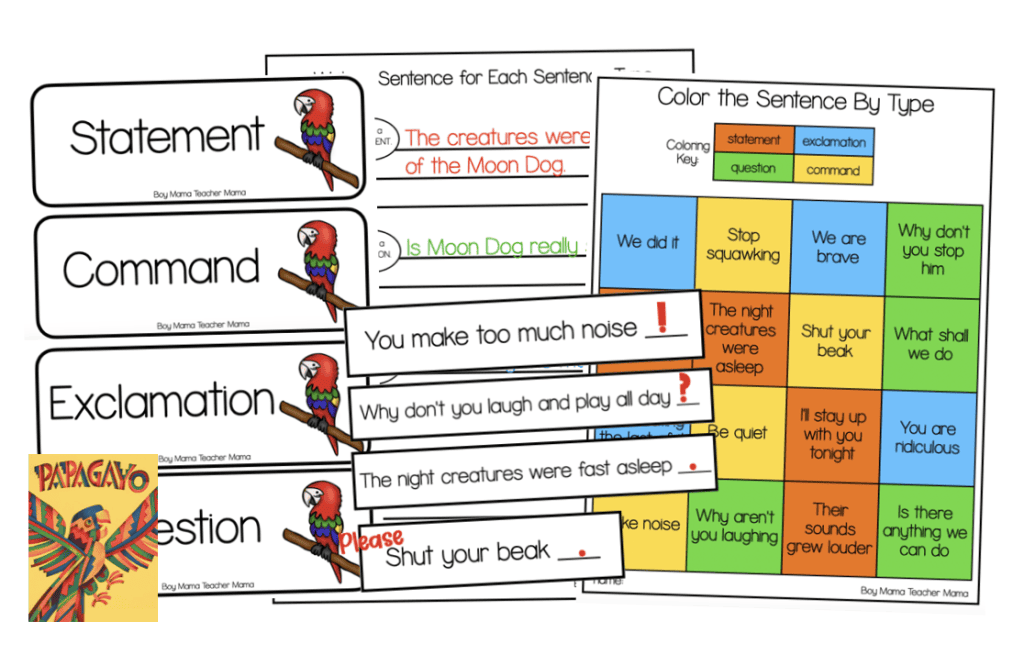
💚 Grab Sentence Types with Papagayo on TpT
Types of Sentences with The Bad Seed
Use The Bad Seed to take sentence types practice a little further with activities that give students opportunities to identify the different sentence types and write sentences of their own.
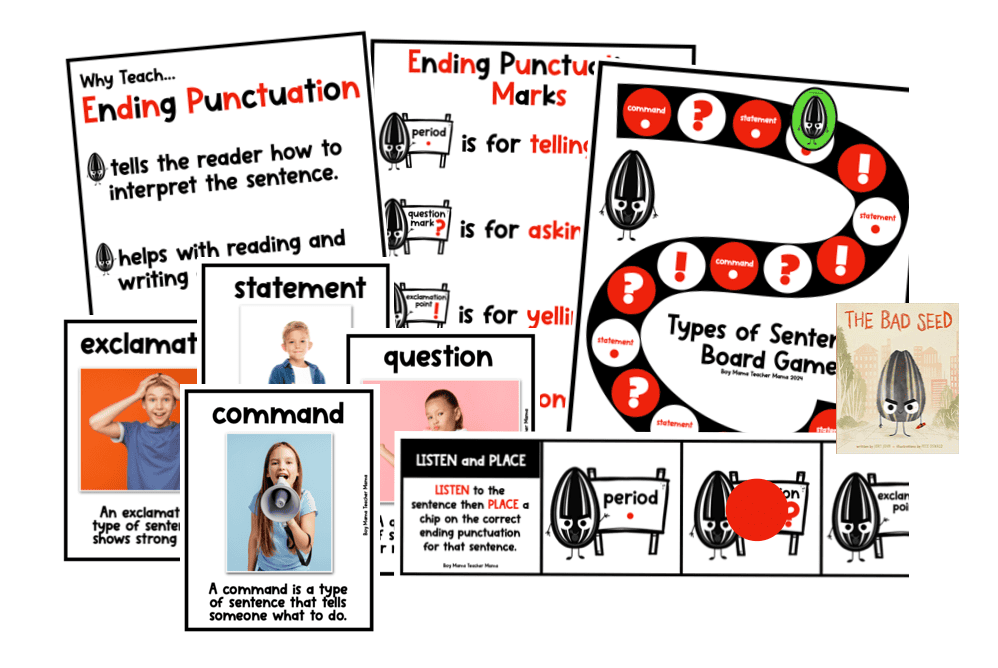
💚 Grab Sentence Types with The Bad Seed on TpT
Types of Sentences with A Fine, Fine School
Continue practicing sentence types with A Fine, Fine School. Students work with statements, questions, exclamations, and commands through activities connected to the story.
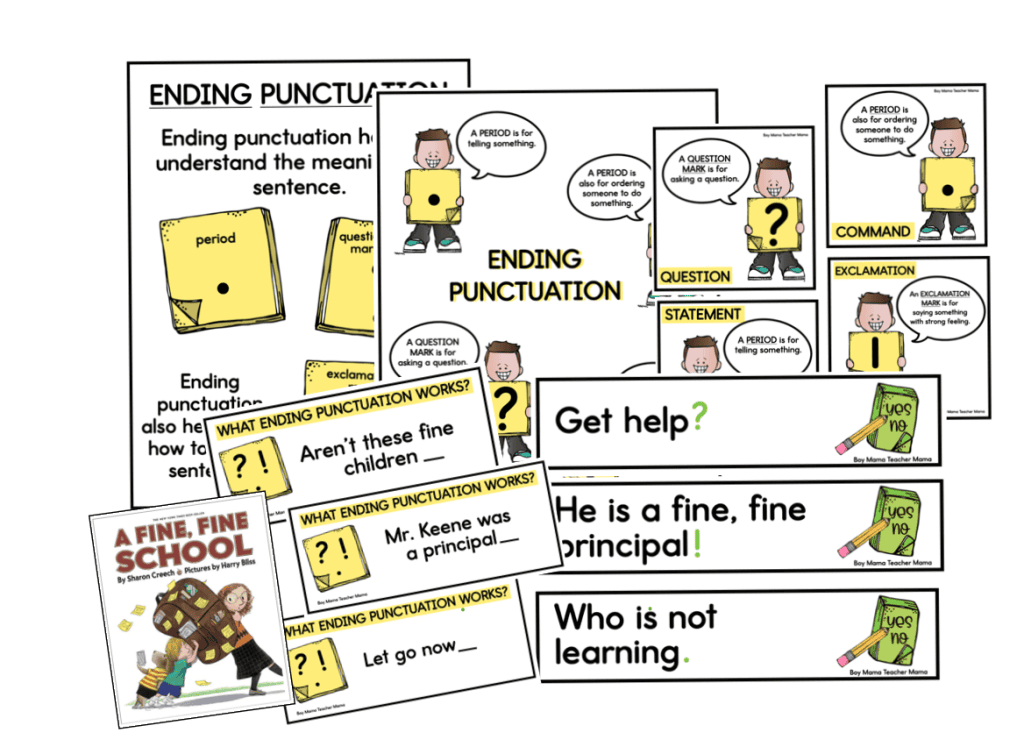
💚 Grab Sentence Types with A Fine, Fine School on TpT
Building Writers One Step at a Time
Learning the four types of sentences gives students another important piece of the sentence-writing puzzle. As they learn to recognize statements, questions, exclamations, and commands, they also begin to understand how writers use different kinds of sentences to express different ideas.
Give students plenty of opportunities to hear, identify, talk about, and write each sentence type. They don’t have to get everything right immediately. For now, we want them to understand that sentences can do different jobs—and begin choosing the right type of sentence for what they want to say.
Looking for more sentence writing practice?
💚 Start with my Sentences and Fragments post to help students recognize the difference between complete sentences and fragments.

If this is your first time visiting Boy Mama Teacher Mama, welcome!
Did you know that you can also find us on Facebook, Instagram, Pinterest, and Teachers Pay Teachers?
© Boy Mama Teacher Mama 2026
All Rights Reserved