

Think Before You Speak: Using Your Social Filter
📝 This post, Think Before You Speak: Using Your Social Filter, was originally published in 2018 and has been updated with new information and resources.
“Your new shoes are ugly.”
“I don’t like your picture.”
“Your lunch smells funny.”
“This dinner is gross!”
Do any of these sound familiar? I have heard them in both my classroom and at home. At first, comments like these surprised me. But then I started asking myself an important question: Have students actually been taught how to use a social filter, or are we expecting them to already know? Most of the time, the answer is no.
After years of searching for the right resource, I finally found it- Julia Cook’s book, I Can’t Believe You SAID That! A Story about Using My Social Filter. It opened the door to conversations about honesty, kindness, and learning that not every thought needs to be said out loud.
Julia Cook’s books are some of my favorite tools for teaching social and emotional skills in a way children understand.
I Can’t Believe You SAID That! A Story about Using My Social Filter by Julia Cook
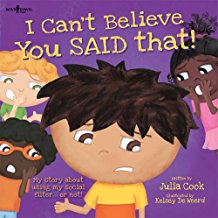
RJ always says exactly what he thinks — no filter, no hesitation! He doesn’t realize his words are hurtful — he thinks he’s just being honest. With help from his parents and teacher, RJ learns that not every thought needs to be said out loud. In fact, sometimes the less said, the better! A wonderfully relatable story that helps children learn the difference between words that you think and words that you say.
What is a Social Filter?
A social filter helps students think before they speak. It encourages children to stop, consider how their words may affect others, and decide whether what they are thinking should be said out loud. Learning this skill helps students build kindness, empathy, and stronger classroom relationships.
Why Teach About Social Filters?
Learning to use a social filter helps students build friendships, communicate respectfully, and become more aware of how their words affect others. This skill supports classroom community and social-emotional learning long beyond the lesson.
Using Your Social Filter Classroom Activity
In this book, Cook explains what a “social filter” is and how and when to use it. She describes the “thinking bubble,” the place where we can think about anything we want, no matter how inappropriate it is. These thoughts move through our social filter, and the bad ones remain in the thinking bubble. The thoughts that are okay to say then move to the “talking bubble” and are said out loud.
After reading and discussing this book in class, the phrases thinking bubble and talking bubble became part of our everyday language. You will often hear me or another student say, “Use your social filter! Does that stay in your thinking bubble or can it move to your talking bubble?” and the kids know exactly what it means.
As a follow-up activity, we practiced using our own social filters together as a class. Here is the scenario I presented to the class:
Your friend just drew a picture of an alien, but you do not like the picture.
I drew this picture on the board with a “thinking bubble” and a “talking bubble.” As a class, we listed some not-so-nice things they might think about the picture and placed them in the “thinking bubble. “We then sent those thoughts through the “social filter” and changed them into words that are not hurtful or judgmental and placed them in the “talking bubble.”

After practicing as a group, I gave each student a scenario like the ones listed below, and they recorded what they might think in the thinking bubble and what they might say in the talking bubble. Here are a few examples.

Scenario: A classmate is reading a really easy book.
Thinking Bubble: “That book is too easy. Do a different book.”
Talking Bubble: “Can I have that book when you’re done?“

Scenario: A classmate has an idea you do not like.
Thinking Bubble: “That idea is horrible.”
Talking Bubble: “Your idea is interesting.”
My students actually loved doing this so much that they begged to do it over and over! The best part was hearing students begin using the language independently throughout the day. It became a simple way for us to pause, think, and choose words that were kind and helpful.
💡 Looking for ready-to-use practice? I created companion activities to go with I Can’t Believe You SAID That! A Story about Using My Social Filter so students can practice identifying thinking bubbles, talking bubbles, and using their social filters in real-life situations.
Grab I Can’t Believe You Said That! Using Your Social Filter Activities for the Classroom on TPT and start practicing social filters in your classroom today!
Have you taught students about using social filters or thinking before speaking? Share your favorite SEL activities below!

If this is your first time visiting Boy Mama Teacher Mama, welcome!
Did you know that you can also find us on Facebook, Instagram, Pinterest, and Teachers Pay Teachers?
© Boy Mama Teacher Mama 2026
All Rights Reserved