


Teaching the Magic
📝This post, Teaching the Magic e, was originally published in 2012 and has been updated with new information and resources.
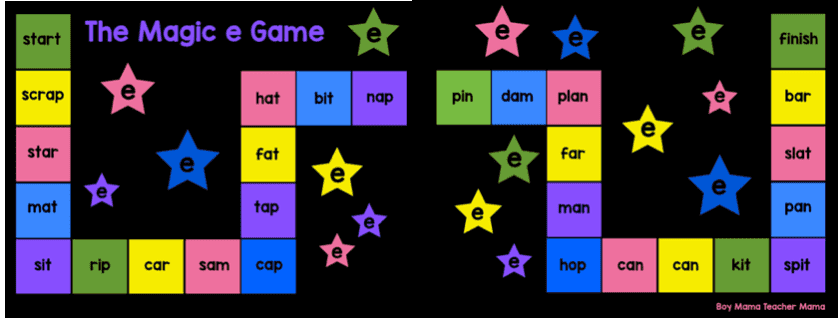
Magic e is one of those phonics concepts that never gets old — for teachers or for students! There is something really satisfying about watching a child realize that one little letter at the end of a word can change everything. Keep reading for our favorite activities and books for teaching the Magic e.
What is Magic e?
Magic e — also known as silent e, bossy e, or final e — is one of the most important phonics concepts young readers learn! Here is how it works: when a word ends in the letter e, that e is silent, and it changes the vowel sound in the middle of the word from a short vowel sound to a long vowel sound. So “cap” becomes “cape,” “pin” becomes “pine,” and “hop” becomes “hope” — all because of that one little e at the end!
Common Magic e Word Pairs
One of the easiest ways for students to understand the magic e is to see how one letter can completely change a word. Here are some common magic e word pairs to practice.
cap→cape
hop→hope
pin→pine
tub→tube
fin→fine
kit→kite
cub→cube
rid→ride
Why Teach Magic e?
Magic e is one of those concepts that unlocks a huge number of new words for young readers and writers! Once students understand this rule, they can decode and spell hundreds of new words independently. It also helps them see patterns in words rather than memorizing each one individually. Magic E is typically introduced in first grade and reinforced in second grade, making it a critical part of your phonics instruction. Magic e also helps students become more flexible readers because they learn that changing just one letter can completely change the meaning and pronunciation of a word.
Activities for Teaching the Magic e
Magic Wand
If there is one Magic e activity that students never seem to get tired of, it is the Magic e wand! There is something magical about transforming a simple CVC word into a brand-new word with just one wave of the wand.
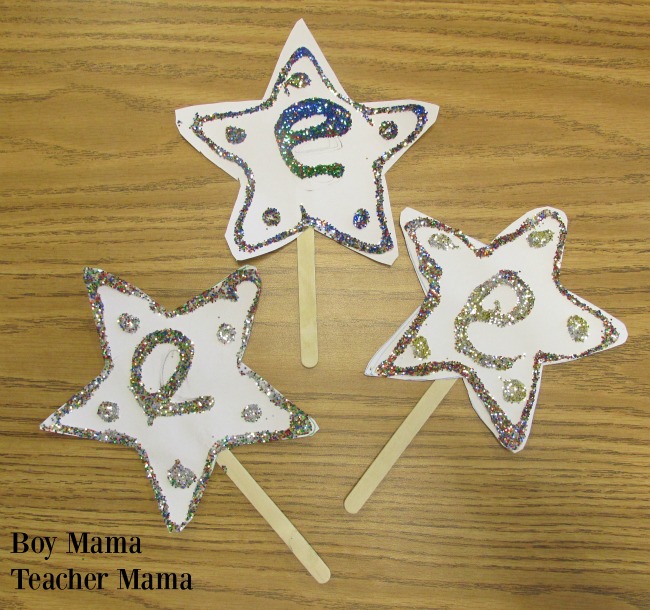
Creating the Wand: Cut out a star from card stock and write the letter ‘e’ in the middle. Have your students decorate the star with glue and glitter, then add a popsicle stick to create a wand.
Using the Wand: Write some basic CVC words on index cards. Read the word, then place the magic wand at the end of the word and read the newly created word.
📝 Looking for CVC words for practicing the magic e? Download our CVC Wordlist here!
Word Cards
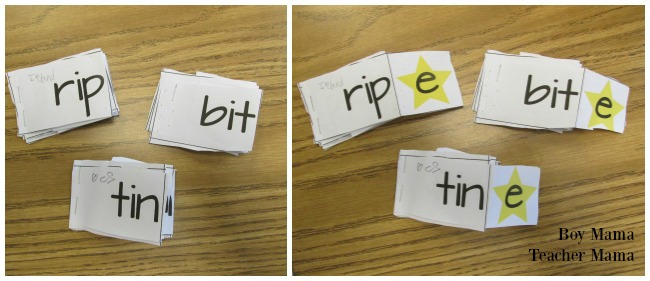
Preparing the Word Cards: Write a CVC word on the card beginning at the left side. Fold the end of the card to create a flap. Write the letter e on the flap.
Using the Magic e Flaps: Read the CVC word first, then lift the flap to add the e, then read the newly created word.
Silly Sentences
Once students understand how Magic e works, it is time to have some fun with it!
Why Write Silly Sentences? Writing silly sentences is a great way to help students practice their Magic e words in context — and the sillier the better! Using both the CVC word and the Magic e word in the same sentence helps students see and remember the relationship between them!
Preparing the Magic e Silly Sentences: Print out the CVC word list. Grab some lined paper for writing.
Writing Silly Sentences: Choose a word from the CVC list, then add the magic e to that word. You now have 2 words to use in your sentence. Use those two words to write a silly sentence. For example: Your words are ‘hop’ and ‘hope.’ The sentence you create might be I hope I can hop!
Nonsense Words
Nonsense Words: Write some words on cards that are not real. Words might be “fut,” “nup” or “vip.” Have students use their magic e wand to change these words into magic e words. For example: “fut” becomes “fute”
📝 Why Use Nonsense Words? Nonsense words are made-up words that follow real phonics rules. If a student can read a nonsense word like “zape” or “fute,” you know they truly understand the Magic E rule — not just the words they have memorized!
💡Add a star above the magic e when writing! This highlights the e and adds some sparkle!!
Looking For Some Books about the Magic e?
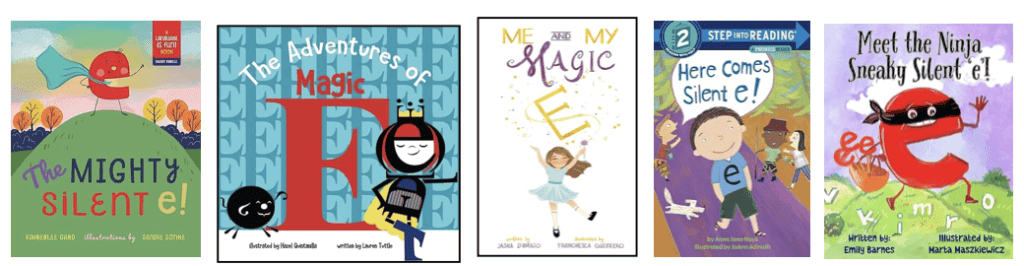
The Mighty Silent e! by Kimberlee Gard
What happens when the silent e goes missing? The classroom erupts in chaos — and dessert is off the table! This fun and clever story shows young readers just how powerful that little e really is!
The Adventures of Magic e by Lauren Tuttle
Magic E is on a mission to help the letters of Letterborough turn short vowels into long vowels — just in time for the school talent show! A fun and engaging story that brings the Magic E rule to life in a memorable way!
Me and My Magic e by Jaska D’Amato
This sweet rhyming story helps beginning readers understand the difference between short and long vowel sounds through the power of Magic e! Perfect for read-aloud and early phonics instruction!
Here Comes the Silent e! by Anna Jane Hays
Silent e gets her very own starring role in this Step 2 phonics reader! Using rhyme and visual clues, this book makes the silent e concept easy and fun for young readers to understand!
Meet the Ninja Sneaky Silent e! by Emily Barnes
Silent e comes to life as a sneaky ninja who transforms words with a quick whoosh and a zip! Kids will love following along as this clever ninja changes “hop” to “hope” and “cap” to “cape!”
Whether you use a wand, silly sentences, games, or books, a little Magic e practice can go a long way in helping young readers build confidence and fluency.
Ready to keep the Magic e fun going? Grab our Activities for Teaching Magic e from our TPT store — everything you need in one place!
Looking for more Magic e resources?

If this is your first time visiting Boy Mama Teacher Mama, welcome!
Did you know that you can also find us on Facebook, Instagram, Pinterest, and Teachers Pay Teachers?
© Boy Mama Teacher Mama 2026
All Rights Reserved

Pingback: Teacher Mama: Magic e Game - Boy Mama Teacher Mama
I use the word magic too, so much fun when it’s magic x
Funny, I’d never thought of it like this – but what a great approach to learning ‘e’
ahhh the Magic ‘e’ 😀 Always my favourite rule to teach the kids. I love when you see it click and they have that aha! moment.
Oh my goodness, you have so many awesome ideas. I love this!! Thank you and off to pin now. 🙂
These look great! I always called it the silent or bossy e but you’re right. The magic e sounds good!! 🙂
I called it the “magic e” too. Much more fun 🙂 Thanks so much for these resources. Pinning this away to use when I return to the classroom. 🙂
Steph, where do you find the time to create this stuff? Honestly, every week you have a new amazing post to help my girls learn plus awesome resources to go along with it. You rock!
More lovely ideas for my classroom, thank you. Pinned it.